Last updated: March 2026 | Reading time: 10 minutes | Suitable for: Unemployed South Africans with any qualification level, including those without matric
If you are unemployed and struggling to find work, the Expanded Public Works Programme (EPWP) may be one of the most accessible opportunities available to you right now. It requires no prior work experience, accepts applicants without matric, and is open to South Africans across all nine provinces.
Yet for a programme this large and this important, it is one of the most poorly explained government initiatives in the country. Most people who search for EPWP jobs find nothing except scattered municipal adverts and confusing government department pages. This guide explains everything clearly and practically: what the EPWP is, how much it pays, what the four sectors involve, what documents you need, and exactly how to get your name onto the EPWP register in your area.
Important: The EPWP is a government programme. You will never be asked to pay money to register or to be placed in a project. If anyone asks you to pay a fee to get onto an EPWP list, it is a scam. Report it to the Department of Public Works at 012 406 1000.
What Is the EPWP?
The Expanded Public Works Programme is a South African government initiative that was launched in 2004 following the Growth and Development Summit. Its purpose is straightforward: create short-term work opportunities for unemployed South Africans while delivering useful services and infrastructure to communities.
The programme is funded by the national government and implemented through national departments, provincial departments, and local municipalities. It is not a single job or a single project. It is an ongoing programme that runs hundreds of simultaneous projects across all nine provinces at any given time.
EPWP work is temporary by design. Contracts typically run from 3 to 12 months, and in some cases up to 24 months. The goal is not to provide a permanent income but to give participants three things that make it easier to find permanent work afterward:
- A daily wage: Income while you are working, paid monthly.
- Work experience: A formal employment record that can go on your CV and be listed as a reference.
- A certificate: At the end of your contract, you receive an EPWP participation certificate that reflects any training you completed and the work you performed.
Since its launch, the EPWP has created millions of work opportunities across South Africa. In 2026 alone, the programme is expected to place over 100,000 participants in active projects.
Who is the EPWP for? The EPWP specifically targets the most vulnerable members of South African society. Government has set participation targets of 55% women, 40% youth (aged 18 to 35), and 2% people with disabilities. If you fall into any of these categories, you have priority access to EPWP placements.
The Four EPWP Sectors: Which One Is Right for You?
The EPWP operates across four distinct sectors, each managed by a different national department. When you register for EPWP in your area, you may be placed in any of these sectors depending on what projects are running near you. Understanding each sector helps you know what kind of work to expect and which one to mention when you register.
| Sector | Led By | Types of Work | Who It Suits | Contract Length |
| Infrastructure | Dept of Public Works and Infrastructure | Road building and repair, bridge maintenance, building construction, plumbing and electrical support, painting and plastering | People willing to do physical outdoor work. Basic artisan skills are an advantage. | 3 to 12 months |
| Environment and Culture | Dept of Environmental Affairs | Clearing invasive plants, land care and erosion control, waste collection and recycling, park and nature reserve maintenance, community clean-ups | People who are comfortable working outdoors in all weather. No experience needed. | 3 to 12 months |
| Social | Dept of Social Development | Early childhood development (ECD) assistant, home-based care for elderly and disabled, community health promotion, school feeding scheme support, social worker assistant | People with patience and a caring nature. Women are particularly encouraged. | 3 to 24 months |
| Non-State (NPO and CWP) | Dept of Cooperative Governance | Community development, NGO programme support, Community Work Programme (CWP) tasks, administrative support for community organisations | People in rural and semi-urban areas. Regular, ongoing part-time work rather than a single project. | Ongoing (CWP) or 3 to 12 months (NPO) |
You do not get to choose your sector in all cases. Placement depends on which projects are active in your municipality at the time you register. However, if you have relevant skills or a preference, mention it when you speak to your ward councillor or municipal EPWP coordinator. Participants with specific skills like bricklaying, plumbing, sewing, or early childhood care are sometimes placed in more specialised roles that pay a higher daily rate.
How Much Does EPWP Pay in 2026?
This is one of the most searched questions about the programme and one of the least accurately answered on existing websites. Here is the confirmed, official figure.
Effective 1 March 2026, the minimum wage for EPWP workers is R16.62 per hour. This rate is set separately from the national minimum wage (which is R30.23 per hour) under a special dispensation for the EPWP. It is lower than the standard minimum wage because the programme’s purpose is work access and skills development, not full employment replacement.
What this means in practice depends on how many hours you work per day and how many days per week your project runs. The table below breaks it down:
| Work Schedule | Hours Per Month | Gross Monthly Earnings | Notes |
| 4 hours per day, 5 days per week | 80 hours | R1,329.60 | Typical part-time EPWP worker |
| 6 hours per day, 5 days per week | 120 hours | R1,994.40 | Common for infrastructure roles |
| 8 hours per day, 5 days per week | 160 hours | R2,659.20 | Full-day, full-week EPWP placement |
| Community Work Programme (CWP) | Approx. 100 hours | R1,662.00 | CWP is typically 2 days per week, ongoing |
Honest expectation: EPWP wages are low. A full-time EPWP placement at the minimum rate pays roughly R2,659 per month before any deductions. This is not a living wage by most standards. What the EPWP offers is not a salary replacement but a stepping stone: income while you build experience, a reference for your CV, and a certificate that opens doors to learnerships and permanent employment. Treat it as a launch pad, not a destination.
Some EPWP projects, particularly in infrastructure where specialised skills are needed or where contractors set their own rates above the minimum, do pay more than the minimum. A participant placed as an artisan assistant on a road construction project may earn R250 to R350 per day depending on the contractor. Always ask the project supervisor about the daily rate before you sign the contract.
How to Apply for EPWP Jobs in 2026: Step by Step
Unlike government jobs advertised on the DPSA vacancy circular, EPWP jobs are not applied for through a single centralised portal. The application process is local and decentralised. Here is exactly how it works.
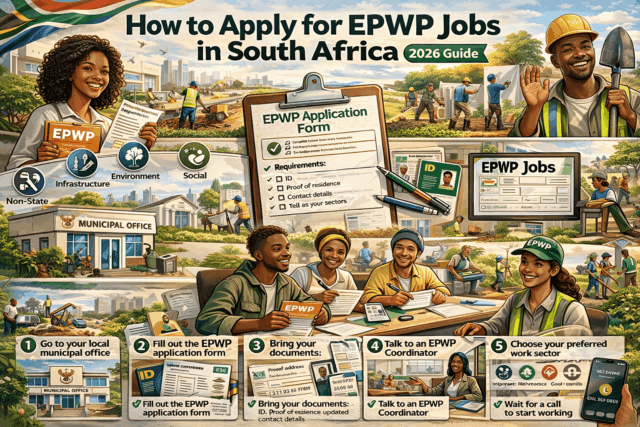
Step 1: Contact Your Ward Councillor
Your ward councillor is the single most important person in the EPWP application process. EPWP labour is recruited locally, and in most municipalities, the ward councillor manages the community register from which EPWP workers are selected for projects.
How to find your ward councillor: Go to the Electoral Commission of South Africa website at www.elections.org.za, enter your address, and your ward number and ward councillor’s contact details will be displayed. Alternatively, visit your nearest municipal office and ask for your ward councillor’s contact details.
When you contact your ward councillor, introduce yourself, explain that you are unemployed and want to register for EPWP work in your ward. Ask when the next registration session is and where it will be held.
Step 2: Register at Your Local Municipality
Most municipalities maintain an EPWP database of unemployed community members who are available for work. When a new project starts, the municipality selects workers from this database based on the project’s requirements.
To register, visit your local municipal offices and ask for the EPWP coordinator or the Community Development office. Bring the documents listed in the section below. Your name will be added to the local labour database.
Important: Register as early as possible. Projects fill quickly once they start, and candidates who are already registered get first consideration. Do not wait until you hear about a specific project before registering.
Step 3: Engage Community Development Workers (CDWs)
Community Development Workers are government-appointed officials who operate at ward level and act as the link between communities and government services. They are often directly involved in EPWP recruitment and can tell you about upcoming projects in your area before they are publicly advertised.
Find your CDW through your ward councillor or your nearest municipal office. Make sure your name is known to the CDW and that they have your current contact number.
Step 4: Check These Official Sources Regularly
EPWP vacancies are not always advertised broadly. Here is where to look:
- Provincial government job portals: Most provinces have a dedicated jobs portal. Gauteng uses jobs.gauteng.gov.za, Western Cape advertises through westerncape.gov.za, and KZN through kznworks.gov.za. See the provincial directory further in this article.
- Municipal websites: Large cities like Johannesburg (joburg.org.za), Cape Town (capetown.gov.za), and eThekwini (ethekwini.gov.za) post EPWP vacancies on their own careers pages.
- Official EPWP website: The national EPWP portal at epwp.gov.za provides programme information and links to department-specific opportunities.
- SAYouth.mobi: The government’s youth employment platform also lists EPWP opportunities. Register a free profile at sayouth.mobi and set up notifications.
- Local newspapers and community noticeboards: Many EPWP projects are advertised through local community newspapers, church noticeboards, and ward meeting announcements. Stay connected in your community.
Step 5: Prepare Your Documents Before You Register
Having your documents ready speeds up registration and shows the coordinator that you are prepared. Here is exactly what you need:
| Document | Details | Required? |
| South African ID document | Green ID book or Smart ID Card. Must be a valid, unexpired document. | Yes, always |
| Proof of residence | A utility bill, affidavit from your ward councillor, or municipal letter confirming your address. Must not be older than 3 months. | Yes, for most municipalities |
| Matric certificate or highest school certificate | Grade 8 to Grade 12 certificate. If you did not complete school, bring whatever you have. | Bring it if you have it |
| CV or work history | Even a simple, one-page CV helps. Include any previous work experience, volunteer work, or skills. | Not always required but strongly recommended |
| Disability documentation | If you have a disability and want to register under the 2% disability target, bring a medical assessment or SASSA disability certificate. | Only if applicable |
| Banking details | A bank account in your own name. If you do not have one, some municipalities arrange payment through cash points or Postbank. | Recommended |
Step 6: Understand the Selection Process
Once you are registered, selection for a specific project is not automatic. Project managers and ward councillors select candidates based on several factors:
- Location: Priority is given to people who live in the ward or community where the project will take place
- Gender targets: Women are prioritised to meet the 55% target
- Youth status: Applicants aged 18 to 35 are prioritised to meet the 40% youth target
- Disability: Applicants with disabilities are prioritised to meet the 2% target
- Skills match: If the project needs specific skills, participants with those skills are selected first
- Previous EPWP participation: In some municipalities, people who have not yet had an EPWP placement are given priority over those who have already participated
If you are not selected immediately, do not give up. Stay in contact with your ward councillor, update your contact details if they change, and check regularly for new project announcements.
Province-by-Province EPWP Directory for 2026
Because EPWP is implemented at provincial and municipal level, where you look for opportunities depends on where you live. Use the table below to find the correct starting point for your province:
| Province | Key Contact / Department | Where to Check for EPWP Jobs | Most Active EPWP Sectors |
| Gauteng | Gauteng Dept of Infrastructure Development | jobs.gauteng.gov.za and gpg.gov.za | Infrastructure, Social (ECD), Environment |
| Western Cape | Dept of Transport and Public Works WC | westerncape.gov.za and local municipal sites | Environment and Culture, Social, Infrastructure |
| KwaZulu-Natal | KZN Dept of Public Works | kznworks.gov.za and local municipality sites | Infrastructure, Social, Environment |
| Eastern Cape | EC Dept of Public Works | dpw.ecprov.gov.za and local municipality sites | Infrastructure, Non-State (CWP), Social |
| Limpopo | Limpopo Dept of Public Works | ldpw.limpopo.gov.za and local municipality sites | Infrastructure, Agriculture support, Social |
| Mpumalanga | Mpumalanga Dept of Public Works | mpumalanga.gov.za and local municipality sites | Infrastructure, Environment, Social |
| North West | NW Dept of Public Works | nwpg.gov.za and local municipality sites | Infrastructure, Social, Non-State (CWP) |
| Free State | FS Dept of Police, Roads and Public Works | freestate.gov.za and local municipality sites | Infrastructure, Social, Environment |
| Northern Cape | NC Dept of Public Works and Infrastructure | northern-cape.gov.za and local municipalities | Infrastructure, Environment, Non-State (CWP) |
If you live in a rural area: Do not assume EPWP work is only available in cities. Many of the highest-volume EPWP projects, particularly in infrastructure and environment, are specifically designed to run in rural and semi-rural areas where unemployment is highest. Your ward councillor is your best starting point, even if there is no municipal website nearby.
What to Expect Once You Are Selected
If you are selected for an EPWP project, here is what happens next.
Signing Your Contract
You will be asked to sign a formal employment contract. This contract is governed by the Ministerial Conditions of Employment for the EPWP, which sets out your rights and obligations. Read it carefully before signing. The contract will state your start date, the duration of the project, your daily rate, your working hours, and the leave conditions you are entitled to.
Key conditions set out in the Ministerial Determination for EPWP workers:
- Working hours: EPWP workers may not work more than 55 hours per week.
- Rest periods: You are entitled to a 12-hour daily rest period and two days off per week.
- Sick leave: You can accumulate 12 sick leave days per year. These do not carry over to a new contract.
- Family responsibility leave: If you work at least four days per week, you are entitled to three days of paid family responsibility leave per year.
- Payment: Payment is made at the end of each month for tasks that have been completed. You will not be paid for days you did not work.
Training During Your Contract
One of the most valuable parts of an EPWP placement is the training. Attend every training session offered to you. The training may be accredited (registered with a SETA and contributing to an NQF qualification) or non-accredited (practical skills training without formal certification). Either way, your certificate at the end of the contract will reflect the training you completed.
Some EPWP projects, particularly in the infrastructure sector, are linked to the Artisan Development Programme or to MERSETA learnerships. Participants who perform well and complete their training may be offered pathways into formal learnerships or apprenticeships. Ask your supervisor about this when you start.
Your Certificate at the End
When your contract ends, you will receive an EPWP participation certificate. This document records the type of work you did, the duration of your contract, and any training or skills assessments you completed. It is a legitimate workplace reference that you can include in your CV and present to future employers.
The certificate is not a matric certificate or an NQF qualification. But it is credible evidence of employment history and it distinguishes you from candidates who have nothing to show. For many entry-level job seekers, the EPWP certificate is the first line on their CV, and it matters.
EPWP vs Learnership vs SASSA SRD: What Is the Difference?
Many people are confused about how the EPWP compares to learnerships and the SASSA SRD grant. The table below explains the key differences so you can choose the right path for your situation:
| EPWP | Learnership | SASSA SRD Grant | |
| What it is | Temporary government work placement | Structured training programme with workplace component | Monthly income grant for unemployed people |
| Minimum qualification | None (Grade 8 or higher preferred) | Usually Grade 11 or 12 | No qualification required |
| Age requirement | 16 and older (18 to 35 preferred) | 18 to 35 (varies by SETA) | 18 to 59 |
| Monthly income | R1,330 to R2,660 (depends on hours) | R2,500 to R8,500 (depends on NQF level) | R370 per month |
| Do you work? | Yes, actual daily work is required | Yes, theory and workplace practice | No, it is a grant not a job |
| Do you get a qualification? | A certificate of participation, not an NQF qualification | Yes, a registered NQF qualification | No |
| How long does it last? | 3 to 12 months per contract | 12 to 24 months | Ongoing (reassessed monthly) |
| Where to apply | Your local municipality or ward councillor | SETA websites, SAYouth.mobi, company career pages | srd.sassa.gov.za or WhatsApp 082 046 8553 |
| Can you receive the SRD grant at the same time? | No. EPWP income makes you ineligible for SRD | No. Learnership stipends make you ineligible for SRD | Not applicable |
Can you receive SASSA SRD while waiting for EPWP? Yes, if you are currently receiving the SRD grant and are unemployed, you can apply for EPWP. However, once your EPWP contract starts and you begin receiving a wage, you must inform SASSA and stop claiming the SRD. Receiving both simultaneously when you are earning is fraud and SASSA’s systems are designed to detect it through bank transaction monitoring.
How to Get the Most Out of Your EPWP Placement
An EPWP contract is temporary. The smartest approach is to use it strategically to set yourself up for permanent employment when it ends. Here is how:
- Attend all training without exception. Every session you miss is a line item that will not appear on your certificate. Show up even when you are tired. The skills and the certificate matter long after the contract ends.
- Build relationships with the project supervisor and site manager. These are the people who will write your reference letter. The ones who show up on time, work hard, and never cause problems on site are the ones who get called back when a new contract starts and the ones who get recommended to permanent employers.
- Ask about progression pathways on day one. Some EPWP projects have formal links to learnerships, apprenticeships, or local employer recruitment. Ask your supervisor directly whether any permanent or extended opportunities come from this project.
- Update your CV the moment your contract is signed. You are now officially employed. Add the position, the employer (the relevant department or municipality), and the start date to your CV. Update it again at the end with your finish date and what you learned.
- Use SAYouth.mobi to register for learnerships at the same time. Your EPWP contract will end. Do not arrive at the end date without a plan. Use the months during your contract to apply for learnerships, entry-level jobs, and other opportunities so you have something lined up before you finish.
- Ask for your certificate in writing before your last day. Do not leave the project without your certificate. If it is not ready, get a written confirmation of your employment from the project manager, including the dates, the type of work, and a contact number. This protects you if the certificate is delayed.
Common Mistakes to Avoid
- Waiting to register until a specific project is advertised: By the time a project is publicly advertised, the local labour database is often already full. Register now, while nothing is happening.
- Losing contact with your ward councillor: Phone numbers change. Make sure your councillor always has your current number. A project can be announced and filled within 48 hours.
- Registering in the wrong ward: EPWP work is allocated to residents of the ward where the project is located. Registering in a ward where you do not live may result in rejection when your address is verified.
- Paying anyone for registration: No legitimate EPWP registration ever costs money. Period.
- Not attending training during your contract: Missing training sessions is noted by supervisors and reduces your chances of being selected for future projects or recommended for learnerships.
- Quitting before your contract ends: If you leave an EPWP project early without a valid reason, it affects your ability to be placed in future projects in that municipality. If you must leave, speak to your supervisor first and follow the correct process.
Frequently Asked Questions
Can I apply for EPWP if I do not have matric?
Yes. The EPWP does not require matric for most placements. The minimum qualification level is Grade 8 for many projects, and some Community Work Programme (CWP) placements have no qualification requirement at all. Bring whatever educational documents you have when you register.
How much does EPWP pay per day in South Africa?
At the official 2026 EPWP minimum wage of R16.62 per hour, a standard 8-hour day would earn R132.96. A typical 6-hour working day would earn R99.72. Some projects, particularly in infrastructure, pay above the minimum depending on the contractor. Ask about the specific daily rate when you register for a project.
How do I find EPWP jobs near me in 2026?
The most reliable method is to contact your ward councillor directly. You can find their details at www.elections.org.za by entering your address. Register your name and contact details with your local municipality’s EPWP coordinator. Check your provincial government’s jobs portal and the SAYouth.mobi platform regularly. Most EPWP projects are filled through the local community register, not through public job adverts.
Is EPWP the same as a permanent government job?
No. EPWP placements are temporary contracts, typically ranging from 3 to 12 months. They do not automatically convert to permanent employment. The programme is designed as a stepping stone rather than a destination: you earn income, gain experience, and receive training that improves your chances of finding permanent work. A small number of exceptional EPWP participants are recommended for permanent positions by their project managers, but this is not guaranteed.
What is the Community Work Programme (CWP) and is it different from EPWP?
The Community Work Programme is part of the Non-State sector of the EPWP. It is different from standard EPWP projects in two important ways. First, it provides regular, ongoing part-time work rather than a single fixed-term contract. Participants typically work two days per week, every week, on community maintenance tasks in their ward. Second, it is specifically designed for the most marginalised communities and has no qualification requirements whatsoever. If you are in a rural or semi-urban area and need regular, ongoing part-time income, the CWP is often more accessible than a standard EPWP infrastructure project.
Can women apply for EPWP?
Not only can women apply, they are actively prioritised. The government has set a target of 55% female participation in the EPWP. This means that in any given recruitment round, project managers are specifically required to ensure that more than half of their placements go to women. Women are strongly encouraged to register and apply.
What does EPWP work actually involve day to day?
It depends entirely on the sector and the project. Infrastructure workers may spend their days clearing drainage channels, applying road markings, or assisting construction teams with manual labour. Environment workers may clear invasive plants, sort recyclables, or maintain public parks. Social sector workers may assist at ECD centres, visit elderly homebound residents, or support community nutrition programmes. Non-State sector workers may do admin support at NGO offices or assist community organisations with outreach activities. Your specific duties will be explained before you sign your contract.
Final Thoughts: The EPWP as a Starting Point, Not a Solution
South Africa’s unemployment crisis is real and deep. The EPWP was not designed to solve it. What it does do is give people at the very beginning of their working lives, or people who have been out of work for a long time, a way to re-enter the workforce with income, experience, and a document to show for it.
For a school leaver with no work history, an EPWP certificate is proof that someone trusted you enough to give you a paid contract and that you completed it. For a 45-year-old who has been retrenched and cannot find work, it is a bridge between nothing and something.
Use it well. Attend your training. Build your relationships. Update your CV from day one. And start looking for your next opportunity before your contract ends. The EPWP is a door. What you do once you walk through it is up to you.
Related posts:
 How to Apply for DPSA Vacancies in South Africa (2026 Step-by-Step Guide)
 SASSA SRD Grant 2026 | How to Apply, Check Your Status and What to Do If You’re Declined
 Learnerships in South Africa 2026 | How to Find One and Apply (Complete Guide)
 South African Government Jobs 2026 | [How to find them and apply]
LEGAL CONTENT DISCLAIMER
The information contained on this website is simply aimed at providing readers with guidance on labour law in South Africa. This information has not been provided to meet the individual requirements of a specific individual. Bizcraft will always suggest that legal advice be obtained to address a person’s unique circumstances. It is important to remember that the law is constantly changing and although Bizcraft strives to keep the information up to date and of high quality, it cannot be guaranteed that the information will be updated and/or be without errors or omissions. As a result, Bizcraft will under no circumstances accept liability or be held liable, for any innocent or negligent actions or omissions which may result in any harm or liability flowing from the use of or the inability to use the information provided.