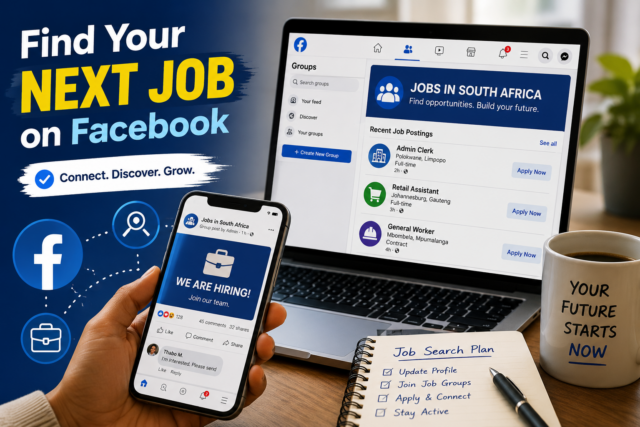
Most South African job seekers know about Pnet, CareerJunction, and Indeed. What many overlook is that Facebook, the platform they already use every day, is one of the most powerful job search tools available, and it costs absolutely nothing to use.
With over 23 million South African users and hundreds of active job-related pages and groups, Facebook has become a genuine alternative to traditional job portals. Companies post vacancies, recruiters are reachable, and entire communities exist purely to connect South African job seekers with employers.
This guide covers 13 practical, actionable tips for using Facebook to find a job in South Africa in 2026, whether you are entering the workforce for the first time, coming back after a gap, or looking for a career change.
Quick Reference: 13 Facebook Job Search Strategies at a Glance
| Strategy | Best For | Effort Level |
| Follow company pages | Spotting early vacancies | Low |
| Join job groups | Volume of daily listings | Low |
| Search bar tactics | Hyper-specific roles/locations | Low |
| Optimise your profile | Being found by recruiters | Medium |
| Post your availability | Network-driven referrals | Low |
| DM recruiters directly | Standing out from the crowd | Medium |
| Engage with company content | Building organic visibility | Medium |
| Use the Facebook search bar creatively | Finding hidden postings | Low |
| Tag-a-friend posts | Warm referrals | Passive |
| Alumni and industry groups | Insider opportunities | Medium |
| Contribute, don’t just lurk | Building credibility over time | Medium |
| Clean up your profile first | Passing the recruiter background check | One-time |
| Update your About section | Passive discoverability | One-time |
1. Follow Company Pages Directly
Many South African companies post vacancies on their Facebook pages before listing them anywhere else. This is especially common among retailers, hospitality groups, mining companies, and public sector organisations that have large social media followings.
The strategy here is simple: make a list of companies you want to work for, find their Facebook pages, and click Follow. Critically, turn on notifications for their posts. That way, when a vacancy goes live, you see it immediately, before hundreds of other applicants flood in.
Pro tip: Search for the company name followed by ‘SA’ or ‘South Africa’ to find the correct local page rather than an international one.
2. Join Job-Specific Facebook Groups
This is where the real volume of Facebook job opportunities sits. There are hundreds of active South African job groups, many of them posting dozens of vacancies every single day.
Some of the most active groups include:
- Jobs in South Africa
- All Jobs South Africa
- Job Hunters in South Africa (over 139,000 members)
- Jobs in Limpopo / Jobs in Polokwane
- Hospitality Jobs South Africa
- Government Jobs South Africa
Search for groups relevant to your province, industry, or job type. Once you join, set your notification preferences so that new posts reach you quickly. Opportunities in popular groups can fill within hours.
Pro tip: Prioritise groups that have active admins and verify postings before sharing them. Groups with vague rules and no moderation are more likely to contain scams.
3. Use the Facebook Search Bar Strategically
Facebook’s search function is more powerful than most people realise. Rather than browsing groups passively, you can search for specific posts using phrases that employers and recruiters actually write.
Try searching for terms like:
- “hiring now Polokwane”
- “vacancy Limpopo 2026”
- “we are looking for a driver Cape Town”
- “urgently required Johannesburg”
- “admin clerk vacancy South Africa”
Switch the filter to Posts and sort by Most Recent to surface fresh listings that may not yet appear in groups or on job portals. This method often surfaces small business vacancies that would never appear on Pnet or Indeed.
4. Clean Up Your Profile Before You Start
Before you do anything else, make sure your Facebook profile presents you well. Recruiters who see your name in a group or receive a direct message from you will look at your profile. What they find there will either open a door or close it.
A few things to action immediately:
- Replace a casual or unprofessional profile photo with a clear, well-lit headshot
- Set any embarrassing posts, photos, or comments to private or delete them
- Make sure your name is your real, full name as it appears on your ID
- Update your current city and province so local recruiters can find you
You do not need to turn Facebook into LinkedIn. But it should not actively work against you either.
5. Update Your ‘About’ Section Like a Mini CV
Many South African job seekers ignore the About section of their Facebook profile entirely. This is a missed opportunity. Recruiters do search Facebook for candidates, and a complete About section makes you far more discoverable.
Include:
- Your current or most recent job title
- Your industry or field (e.g. “Hospitality | Lodge Management | Limpopo”)
- Your key skills in plain language
- Your general location
- A brief, professional bio in the Intro section
Pro tip: Use the same keywords in your About section that recruiters would type into the Facebook search bar when looking for a candidate like you.
6. Post That You Are Looking for Work
One of the most underused tactics on Facebook is simply posting that you are open to opportunities. A well-written post, shared to your personal profile, can reach hundreds of people through shares, reactions, and mutual connections, many of whom you would never think to contact directly.
Your post should include:
- Your field or role type (e.g. bookkeeper, safety officer, hospitality manager)
- Your location and whether you are open to relocation
- Your level of experience
- A call to action (“Please tag, share, or DM me”)
Keep it professional and specific. Vague posts like “looking for any job” rarely travel far. A post like “Qualified HR professional with 5 years experience in mining, based in Rustenburg, open to opportunities in Limpopo or North West” is far more likely to result in a lead.
7. Message Recruiters Directly
Recruitment professionals are highly active in South African job groups. Many of them post multiple vacancies daily. Rather than only responding to individual posts, it is completely acceptable to send a polite, concise direct message introducing yourself.
A good recruiter DM on Facebook should:
- Be short (four to six sentences maximum)
- State your name, current role or background, and what you are looking for
- Reference something specific (e.g. “I saw you regularly post hospitality roles in Limpopo”)
- Ask whether there is anything suitable coming up, not whether they can find you a job
Most recruiters will either respond with something relevant or file your details for future reference. Either outcome is better than waiting passively.
8. Engage With Company Content
This tip is slower-burning but genuinely effective. When you comment thoughtfully on a company’s Facebook posts, your name appears in front of their team, their followers, and anyone watching that company’s page.
You are not commenting to beg for a job. You are commenting to demonstrate knowledge, interest, and professionalism. Over time, this builds visibility with employers before a formal application has even been made.
Example: A company in your sector posts about a new initiative or achievement. You leave a comment like: “Really interesting approach to guest experience. I have been following your expansion into Limpopo and it has been impressive to watch.” That comment gets seen.
9. Watch for Tag-a-Friend Vacancy Posts
A very common format for South African vacancies on Facebook is the “tag a friend” post. A company or recruiter posts a vacancy and adds a line like: “Know someone perfect for this role? Tag them below.”
Getting tagged in one of these posts is essentially a warm referral. It puts you in front of the employer with someone else’s endorsement attached. You cannot entirely control whether you get tagged, but you can increase the odds by:
- Being active and visible in relevant groups so people associate you with certain skills
- Letting your network know you are looking, so they think of you when they see these posts
- Reciprocating by tagging others, which builds goodwill in your network
10. Join Alumni and Industry Community Groups
Beyond dedicated job boards, Facebook has thousands of industry-specific and alumni-based communities where job opportunities are shared informally. These groups often post vacancies before they go anywhere public, and referrals from within the group carry weight.
Search for groups linked to:
- Your university or college
- Your industry (e.g. mining, retail, agriculture, healthcare, construction)
- Your professional body or trade association
- Your region or province
Being part of these communities keeps you close to the informal job market, which in South Africa accounts for a significant portion of how people actually find work.
11. Contribute, Do Not Just Lurk
In any Facebook group, the people who get noticed are the ones who add value, not the ones who scroll silently. If you want to be remembered when someone in the group sees a vacancy that fits your profile, you need to be a familiar, credible name in that group.
This does not require much time. A few times a week:
- Answer a question someone has posted in a job-seeking group
- Share a useful article relevant to the group’s topic
- Congratulate someone who has posted good news about a new job
- Welcome new members if the group allows it
When you eventually post asking about opportunities or sharing your CV, you are not a stranger. You are someone the group already recognises.
12. Set Up Notifications in Your Key Groups
Joining the right Facebook groups means nothing if you never see new posts. Facebook’s default notification settings are conservative, meaning many posts will never appear in your feed unless you adjust them.
For each job group you join, go to the group and change your notification settings to All Posts, or at minimum Highlights. This ensures that when a vacancy is posted that matches your field, you see it in time to act.
Speed matters. Some South African job postings on Facebook attract dozens of applications within an hour. Being first with a well-prepared response is a real competitive advantage.
13. Treat Facebook as Part of a Broader Strategy
Facebook is a powerful tool, but it works best when combined with other job search channels. Use it alongside formal portals like Pnet and CareerJunction, direct company applications, LinkedIn for professional networking, and in-person networking wherever possible.
Think of Facebook as your informal, always-on layer of job searching. It surfaces opportunities that never make it to formal portals. It gives you direct access to recruiters. And it leverages the most powerful resource in any job search: other people.
Final note: The South African job market in 2026 is competitive. Candidates who use every available tool, including Facebook, give themselves a meaningful edge over those who do not.
Summary
Facebook is not a replacement for a strong CV or professional job portal. But for South African job seekers, it is an underused advantage. Millions of your fellow South Africans are already on the platform. So are the companies hiring them. With the right approach, you can tap into that network, find opportunities ahead of the competition, and put yourself in front of the right people, all for free.
Start with one or two tips from this list. Join a relevant group, update your About section, or send one well-crafted message to a recruiter. Small, consistent actions compound quickly.
Frequently Asked Questions
Can you really find a job through Facebook in South Africa?
Yes. Many South African companies, especially smaller businesses, retail chains, and hospitality groups, post vacancies exclusively on Facebook before using formal portals. Recruiter activity in South African Facebook groups is also high, making it a legitimate and practical job search channel.
Which Facebook groups are best for job searching in South Africa?
Groups like Jobs in South Africa, All Jobs South Africa, and Job Hunters in South Africa have tens of thousands of active members and post verified vacancies daily. Industry-specific and province-specific groups are also valuable for targeted searches.
Is it appropriate to message a recruiter on Facebook?
Yes, provided you keep the message concise and professional. Recruiters who post in job groups are actively engaging with job seekers and typically welcome direct enquiries. A short, specific message is far more effective than a long or vague one.
Does Facebook have its own jobs feature?
Facebook previously had a dedicated Jobs tab that was widely used in South Africa. While its availability has changed over time, the majority of Facebook-based job searching in South Africa now happens through groups, company pages, and public post searches rather than a centralised jobs feature.
Related posts:




LEGAL CONTENT DISCLAIMER
The information contained on this website is simply aimed at providing readers with guidance on labour law in South Africa. This information has not been provided to meet the individual requirements of a specific individual. Bizcraft will always suggest that legal advice be obtained to address a person’s unique circumstances. It is important to remember that the law is constantly changing and although Bizcraft strives to keep the information up to date and of high quality, it cannot be guaranteed that the information will be updated and/or be without errors or omissions. As a result, Bizcraft will under no circumstances accept liability or be held liable, for any innocent or negligent actions or omissions which may result in any harm or liability flowing from the use of or the inability to use the information provided.