Published: April 2026 | For: South African job seekers across all sectors | Sources: Daily Maverick, Business Day, Mail & Guardian, Standard Bank, Investec, SAPICS, Atlantic Council, Business Tech, ACLED, Wikipedia Economic Impact article, TimesLive UN-AU-AfDB report | Note: This article reflects conditions as of 7 April 2026. The situation is active and evolving.
Important context: The conflict described in this article — the US-Israeli war against Iran — began on 28 February 2026 with surprise airstrikes that killed Supreme Leader Ali Khamenei. As of 7 April 2026, the war remains active. Iran has rejected proposals for a temporary ceasefire. The Strait of Hormuz, through which approximately 20% of the world’s seaborne oil supply passes, remains disrupted. No reliable resolution timeline exists. The economic analysis in this article is based on current data and the best available forecasts from South African economists and international institutions. It is not speculation. But it is subject to rapid change if the conflict escalates, de-escalates, or resolves.
There is a war happening on the other side of the world, and it is already in your wallet. Whether you know it yet or not, the conflict between the United States, Israel, and Iran is reshaping the South African job market in ways that will matter to every person searching for work over the next three to twelve months.
The fuel price increase arriving in April 2026 is described by independent economist Elize Kruger as the highest ever implemented in a single month in South Africa. The JSE lost approximately R2 trillion in value in the first week of March. The rand is weakening. Inflation forecasts have been revised upward. Interest rate cuts that were expected in 2026 have been shelved. The government has cut fuel levies by R3 per litre as an emergency measure — and even that may not be enough.
For a job seeker in South Africa right now, this creates a situation that is simultaneously more difficult and more nuanced than it appears. Some sectors are genuinely expanding because of this conflict. Others are contracting. And how you position yourself in the next three months will matter more than it would have in a stable economic environment.
This article is an honest, research-grounded guide to what the Iran conflict means for South African employment, what the economists are actually saying, where the jobs are growing and where they are shrinking, and how to adjust your approach accordingly.
What Is Actually Happening: The Situation as of April 2026
The 2026 Iran war began on 28 February when the United States and Israel launched surprise strikes on Iran, assassinating Supreme Leader Ali Khamenei and targeting nuclear and military infrastructure. Iran retaliated with missile and drone strikes against Israel, US military bases, and Gulf Cooperation Council countries, and by restricting traffic through the Strait of Hormuz, the narrow waterway through which roughly 20% of the world’s seaborne oil supply passes.
This is not a contained regional skirmish. Iran attacked all six Gulf Cooperation Council countries — Bahrain, Kuwait, Oman, Qatar, Saudi Arabia, and the UAE. LNG production facilities in Qatar were hit, reducing output capacity by 17%. Major commercial airports across the Middle East have been disrupted or closed. Shipping routes that normally pass through the Persian Gulf and Suez Canal are being rerouted around the Cape of Good Hope. Oil prices have surged over 40% since the strikes began.
As of 7 April 2026, Iran has rejected American proposals for a temporary ceasefire, demanding a permanent end to the conflict. Trump has issued ultimatums, threatened further strikes, and described the US objective as both disabling Iran’s nuclear programme and achieving regime change. Neither outcome is imminent. The consensus among analysts is that this conflict will not resolve quickly.
How South Africa Is Connected to This
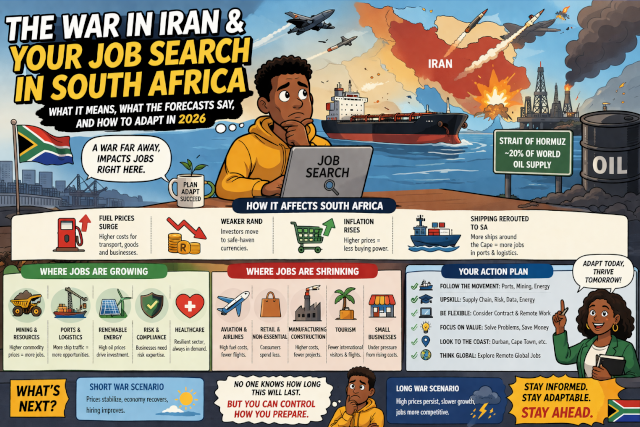
South Africa is not a participant in the conflict. But as an oil-importing economy in a globalised energy market, it is not insulated from it either. The connections run through four direct channels:
- Fuel prices: South Africa imports approximately 80% of its liquid fuels. When the global oil price rises sharply, South African petrol and diesel prices follow. The April 2026 increase is historically unprecedented. Higher diesel prices directly increase the cost of transporting goods, running agricultural equipment, generating backup power, and operating construction machinery.
- Currency: Geopolitical crises push investors toward safe-haven currencies, primarily the US dollar, and away from emerging market currencies like the rand. A weaker rand amplifies the oil price shock, because fuel is priced in dollars but paid for in rand.
- Inflation and interest rates: Higher fuel costs feed directly into transport, food production, and manufacturing costs. When inflation rises, the Reserve Bank either holds rates higher for longer or increases them. Either outcome suppresses economic activity, investment, and hiring.
- Shipping rerouting: The displacement of shipping away from the Middle East and through the Cape of Good Hope is the one structural channel through which South Africa could benefit. Durban, Cape Town, and East London ports are seeing increased vessel traffic. This creates genuine, concrete demand for port and logistics workers.
Where South Africa Stands Right Now: A Snapshot
The table below draws on statements from Standard Bank, Investec, Nedbank, North-West University, the University of Johannesburg, SAPICS, Aluma Capital, and reporting from Business Day, the Mail & Guardian, Daily Maverick, and Business Tech:
| Factor | Current Position (April 2026) |
| Oil price | Brent crude trading above $100 per barrel since early March, peaking near $120. Oil prices have surged approximately 40 to 50% since the strikes began on 28 February 2026. |
| South African petrol price | The April 2026 increase is described by independent economist Elize Kruger as ‘the highest ever implemented in a single month in South Africa’. A temporary R3/litre fuel levy reduction was announced by Finance Minister Godongwana, lasting until at least end of April. |
| South African rand | Under significant pressure against the US dollar as investors move to safe-haven currencies. The rand is approaching its weakest levels since mid-December 2025. |
| Inflation forecast | Standard Bank and Investec analysts project inflation could spike to around 5% in April and May. The SARB’s 3% target is under threat. Interest rate cuts that were expected have been indefinitely postponed; rate hikes are now being discussed. |
| JSE performance | The JSE fell 9.2% in the first week of March, wiping roughly R2 trillion from market capitalisation. Year-to-date gains were almost entirely erased. |
| GDP growth forecast | Standard Bank projects SA real GDP growth of 1.5% for 2026, revised down. ‘There is downside risk to our growth forecasts if the war proves protracted,’ the bank states. A sustained $10 increase in the oil price trims SA GDP growth by approximately 20 basis points. |
| Durban port activity | Increasing, as shipping routes divert around the Cape of Good Hope rather than the Middle East corridor. The rerouting adds costs but increases throughput. |
| Aviation | Severely disrupted. Emirates and Qatar Airways flights cancelled. Airspace closures across the Middle East. Jet fuel prices rose 70% in a single week at Cape Town and King Shaka International. Local airlines have imposed fuel surcharges. |
| South Africa’s diplomatic position | South Africa has not participated militarily. However, SA’s political alignment with Iran creates ‘renewed political pressure’ and elevated sovereign and corporate risk in relation to the United States, according to Aluma Capital Chief Economist Frederick Mitchell. |
| Conflict status (as of 7 April 2026) | Active conflict. Iran has rejected a US proposal for a temporary ceasefire, demanding a permanent end to the war. Ongoing US-Israeli strikes on Iran. Trump has issued ultimatums over the Strait of Hormuz. No clear resolution timeline. |
On South Africa’s diplomatic position: Aluma Capital Chief Economist Frederick Mitchell specifically warned that South Africa’s historical alignment with Iran creates ‘renewed political pressure’ and ‘elevated sovereign and corporate risk’ in relation to the United States. American companies operating in South Africa, or South African companies with significant American business relationships, may face pressure. This is a political economy risk that sits on top of the straightforward economic risks. It is not dominant, but it is real and worth monitoring.
Where the Jobs Are Growing: Sectors Likely to Hire More
Not every consequence of this conflict is negative for South African employment. The disruption to global energy markets and shipping routes creates genuine, concrete opportunities in specific sectors. The table below identifies seven sectors where demand for workers is growing or is likely to grow, with the economic reasoning and the specific roles that are in demand:
| Sector | Why Demand Is Growing | Specific Roles to Target | Realistic Timeline |
| Mining: Gold and Precious Metals | Gold prices surged during the conflict as global investors sought safe-haven assets. South Africa is the world’s seventh largest gold producer. When gold prices rise, mines become more profitable and increase production. The Mail & Guardian and Standard Bank both noted that rising precious metals prices provide a partial buffer to SA’s economy. PGMs (platinum group metals) are also rising. | Mining engineers, geologists, metallurgists, mine surveyors, environmental compliance officers, mine safety officers, production supervisors, drill operators, community liaison officers. | Immediate to 3 months. Price signals translate into hiring decisions within weeks at established mines. |
| Port Logistics and Shipping (Durban, Cape Town) | Shipping routes are diverting around the Cape of Good Hope to avoid the Middle East war zone. Durban port, Walvis Bay (Namibia), and Maputo (Mozambique) are all seeing increased traffic. SAPICS (the Supply Chain industry body) explicitly confirms increased logistics activity. This is the most direct structural benefit South Africa receives from the conflict. | Stevedores and port operations staff, logistics coordinators, freight forwarders, customs agents, supply chain analysts, maritime compliance officers, warehousing staff, crane operators, heavy vehicle drivers with port experience. | Immediate. Increased ship traffic is already occurring. Hiring to support higher throughput starts now. |
| Energy: Renewables and Alternatives | The Atlantic Council notes that the Iran war is ‘bolstering the necessity for renewable energy as solar and wind power can reduce vulnerability to external supply.’ South Africa’s vulnerability to imported oil has been dramatically exposed. Government and private sector commitment to the energy transition is being accelerated by the reality of $100+ oil. The Minerals Council confirmed commitment to renewable energy investment at Mining Indaba 2026 in March. | Solar installation technicians, wind energy engineers, energy storage specialists, electrical engineers (renewable focus), project managers for IPP (independent power producers), grid technicians, energy auditors, environmental assessors. | 3 to 12 months. Investment decisions take time to translate into hiring, but the policy environment is now more urgent than ever. |
| Coal Mining | Coal prices have strengthened as global energy markets scramble for alternatives to Middle Eastern oil and gas. South Africa is a major coal exporter, particularly to Asia. Mpumalanga’s coal belt is well positioned. Standard Bank’s Moolman specifically cited rising coal prices as providing a partial offset to SA’s oil import burden. | Coal mining engineers, geologists, blast technicians, logistics drivers (for coal export routes), port operations staff at Richards Bay Coal Terminal, environmental compliance officers, mine health and safety officers. | Immediate to 3 months. Export prices are already elevated; production ramp-up follows quickly. |
| Supply Chain and Logistics (Domestic) | SAPICS president Thato Moloi states that ‘organisations that have redesigned their supply chains to absorb disruption’ and invested in ‘skilled, knowledgeable, suitably qualified supply chain professionals will be best placed to weather the impacts.’ Companies are urgently reviewing their supply chains. Rerouted shipping means longer lead times and higher complexity, requiring more professional management. | Supply chain managers, procurement specialists, logistics analysts, demand planners, transport coordinators, import/export clerks, warehousing supervisors, freight brokerage staff. | 1 to 6 months. Most urgent in companies with significant imported raw materials or goods. |
| Healthcare and Essential Services | Rising inflation, higher cost of living, and stress-related health concerns tend to increase demand for healthcare services. South Africa’s public and private healthcare sectors face increased pressure. Additionally, the UN report presented at the African Development Bank meeting noted that ‘healthcare remains underfunded’ across Africa and called for increased prioritisation. | Nurses (especially in community health), pharmacists, community health workers, healthcare administrators, medical laboratory technicians, occupational health practitioners (particularly in mining and logistics). | Ongoing. Healthcare demand is structurally high and not directly tied to the conflict timeline. |
| Financial Services: Risk and Compliance | Currency volatility, inflation risk, elevated sovereign risk, and potential interest rate changes create enormous demand for financial risk management expertise. The rand’s vulnerability, combined with South Africa’s geopolitical exposure, means banks, insurers, and corporate treasuries need more risk professionals, not fewer. | Risk analysts, credit analysts, forex traders and analysts, compliance officers, economists, actuaries, financial modellers, treasury analysts, insurance underwriters specialising in political or trade risk. | Immediate to 3 months. Risk functions are among the first to be bolstered in a volatile environment. |
The most immediately actionable opportunity: The rerouting of global shipping through the Cape of Good Hope is not speculative. It is already happening. UN, African Union, and African Development Bank reporting from 2 April 2026 explicitly confirms that ‘rerouted transport is already increasing traffic through Durban, the Port of Maputo in Mozambique, Walvis Bay in Namibia, and Mauritius.’ If you have any skills adjacent to port operations, logistics, freight forwarding, customs, or supply chain management, this is the moment to pursue those connections aggressively.
Where the Jobs Are Shrinking: Sectors Under Pressure
The same forces that create opportunities in some sectors create headwinds in others. The table below identifies the six sectors where hiring is slowing or where the risk of retrenchment is elevated, along with the specific reasons and a realistic forecast:
| Sector | Why Hiring Is Slowing | What This Means in Practice | Forecast |
| Aviation and Air Travel | Jet fuel prices rose up to 70% in a single week at South African airports. Middle East airspace closures have forced longer, more expensive rerouting. Emirates and Qatar Airways have cancelled flights. FlySafair, Airlink, and SAA have all applied fuel surcharges. The economic impact of the 2026 Iran war Wikipedia entry describes aviation disruption as among ‘the biggest since COVID-19.’ | Airlines are not expanding. They are cutting costs. Cabin crew recruitment, ground handling staff expansion, and airline operations hiring are effectively frozen. Airport retail and hospitality within airports is also contracting. Workers already in aviation face possible retrenchments if the conflict is prolonged. | Negative for at least 3 to 6 months. Recovery depends entirely on the conflict timeline and fuel price trajectory. |
| Tourism (International Inbound) | The University of Johannesburg’s Dr Ntokozo Nzimande specifically identified tourism as a transmission channel for economic harm: ‘The airspace in some countries in the Middle East has been closed and if this expands, flight routes will become longer and more expensive… that will affect GDP through the tourism sector.’ Higher airfares, flight cancellations, and general geopolitical anxiety reduce international visitor numbers. | Hotels, lodges, and tour operators that depend on international arrivals are seeing reduced forward bookings. Hospitality hiring for front-line, management, and guide roles tied to international tourism is under pressure. Domestic tourism may partially compensate, but cannot replace international spend. | Negative while conflict persists. Domestic tourism and mid-market South African travellers offer a partial buffer. |
| Retail (Consumer Discretionary) | Higher fuel prices mean higher transport costs, which flow directly into the price of goods. Inflation squeezes household budgets. Disposable income falls. Consumers cut back on non-essential purchases. The PayInc index projects inflation rising from 3.2% in March to 4.5% in April. Nedbank’s Nicky Weimar notes that fuel levy increases ‘will translate into a sharp increase in average petrol prices from April.’ | Retailers are not expanding headcount in a declining consumer environment. Non-essential retail (clothing, electronics, furniture) is more vulnerable than grocery retail. New store openings and seasonal staff increases are being deferred. | Negative while inflation is elevated. Food and essential retail is relatively resilient; discretionary retail is not. |
| Manufacturing (Import-Dependent) | Local carmakers were already under pressure before the conflict, and Bloomberg reported that major job cuts had been announced. A major South African steelmaker was planning to close entirely. Manufacturers that rely on imported inputs face sharply higher costs. The SAPICS supply chain analysis confirms that ‘rising logistics costs can ripple through the economy and contribute to broader inflationary pressures.’ | Manufacturers facing higher input costs typically respond by reducing headcount before cutting production. Automotive, steel, and chemical manufacturing are most exposed. Workers in these sectors face an elevated risk of short-time work or retrenchment. | Negative. Pre-existing structural pressure in local manufacturing is worsened by the conflict. Recovery requires both oil price stabilisation and structural competitiveness reforms. |
| Construction (Residential and Commercial) | Higher interest rate expectations, driven by inflation from the oil shock, reduce demand for mortgages and commercial development lending. Forward-rate agreements are pricing in three 25-basis-point rate hikes by November, according to reporting on the AmCham announcement about fuel levy cuts. Projects that were viable at 8% interest rates may not proceed at 8.75% or higher. | Fewer new residential and commercial developments will be started. Construction companies planning to hire in anticipation of project pipelines will defer those plans. Civil and structural engineering roles tied to new private sector development are at risk. | Negative in the short term. Infrastructure and government-funded construction is less affected than private sector development. |
| Small and Medium Business (General) | Small businesses are disproportionately exposed to fuel price increases because they typically cannot absorb higher operating costs the way large companies can. Higher transport costs affect delivery-based businesses, mobile businesses, and any SME with a physical distribution requirement. Higher inflation reduces consumer spending that SMEs depend on. | SMEs are the most likely to defer hiring, reduce hours, or retrench workers in response to cost pressure. A job seeker targeting small businesses in non-essential consumer sectors should be prepared for a difficult market in the short term. | Negative in the short term. SMEs in essential services, logistics, and digital sectors are more resilient than consumer-facing SMEs. |
On the aviation sector specifically: Aviation has been hit particularly hard. Business Tech reports that the disruption is ‘the biggest we have had’ since 9/11 and COVID-19. Jet fuel prices at South African airports rose as much as 70% in a single week. Airlines are not hiring. They are managing cash flow. If you are currently in aviation or had been targeting aviation roles, this is not the time. The sector will recover when the conflict resolves and fuel prices normalise — but that timeline is genuinely unknown.
What the Economists Are Actually Saying: The Forecasts
It is worth reading what South Africa’s most credible economic voices are saying directly, rather than through speculation. Here are the key statements from the available research:
On the oil price and inflation
Standard Bank’s Elna Moolman projects that ‘inflation might spike to around 5% in April and possibly May, depending on how the war unfolds.’ At oil prices of $110 or higher, Investec’s Annabel Bishop calculates that consumer inflation could exceed 4% year-on-year in the second quarter of 2026. The Stanlib chief economist Kevin Lings calculated that at $120 per barrel, South Africa’s under-recovery in petrol prices would ‘jump to around R5.40 per litre and R10 per litre for diesel.’ The PayInc index projects full-year average inflation of 4.4%, higher than the SARB’s 3% target.
On economic growth
Standard Bank projects real GDP growth of 1.5% for 2026, with explicit downside risk if the conflict is prolonged. Their modelling suggests ‘a sustained rise in oil prices could trim South Africa’s economic growth by about 20 basis points for every $10 increase in crude.’ At current oil prices significantly above pre-conflict levels, the growth drag is material. The original government forecast of 1.6% growth has already been complicated by the conflict.
On interest rates
The war has dramatically complicated the SARB’s rate path. Before the conflict, interest rate cuts were anticipated. Now, forward-rate agreements are pricing in three 25-basis-point hikes through November. If rates rise rather than fall, mortgage affordability declines, business borrowing becomes more expensive, and economic activity slows. This is the most consequential long-term employment implication of the oil shock.
On the potential upside
The Mail & Guardian cites Elna Moolman’s observation that ‘the impact of higher oil prices on growth and the current account should be diluted by the rise in coal prices as well as spiking precious metals prices.’ South Africa as a major producer of gold, platinum group metals, and coal benefits from the safe-haven and energy-substitution effects of the conflict. The Atlantic Council similarly notes that the war ‘could present new opportunities for Africa in the global energy landscape’, including through infrastructure investment and commodity price gains.
On the duration
Standard Bank’s baseline model ‘incorporates a short-lived war’, meaning their relatively moderate forecast of 1.5% growth depends on the conflict ending within weeks. If the war is prolonged, their economists explicitly acknowledge that their forecasts carry significant downside risk. As of 7 April 2026, the conflict shows no signs of imminent resolution. Job seekers should plan for a scenario where elevated oil prices and economic uncertainty persist through mid-2026 at minimum.
How to Adjust Your Job Search: Eight Practical Adaptations
Understanding the economic landscape is useful. But the purpose of this article is not analysis for its own sake. It is to help you make better decisions in your job search right now. The table below translates the economic picture into eight specific adjustments that improve your positioning in the current market:
| Adjustment | Why It Matters Right Now | How to Do It |
| Follow the money, not the habits | Most job seekers apply to the same sectors they always have. But when oil prices surge, gold prices rise, port activity increases, and risk functions expand, the hiring is not where it was six months ago. The map has changed. | Before your next application session, spend 30 minutes reviewing commodity price movements, port news, and any South African business news about sector expansions. Target sectors with announced activity, not sectors you are comfortable with. |
| Emphasise cost-efficiency and resilience in your CV and cover letter | Every South African employer is facing higher costs right now. Hiring managers are under budget pressure. A candidate who can demonstrably reduce costs, improve efficiency, or manage supply chain complexity becomes more valuable, not less, in this environment. | Review your CV for any achievement that involved saving money, reducing waste, improving a process, or managing logistics complexity. Bring these to the front. For cover letters, acknowledge the business environment briefly and position your value in terms of what you will contribute to the business’s resilience. |
| Be open to contract and temporary work | In an uncertain economic environment, South African employers are cautious about permanent headcount commitments. Contract and fixed-term appointments allow them to bring in skills without long-term cost obligations. The research confirms that ‘demand for temporary employment services’ is increasing as companies reduce staff costs. | Actively search for contract roles on PNet, Careers24, and LinkedIn. Do not dismiss fixed-term positions. In practice, many contract roles convert to permanent when the business environment stabilises. A contract position also provides income, builds your CV, and puts you inside a company where you can demonstrate your value. |
| Update your skills profile around energy, supply chain, and risk | These three areas are structurally in demand for reasons that predate the conflict and are now intensified by it. A job seeker who can legitimately add ‘supply chain risk analysis’ or ‘energy market fundamentals’ to their profile stands out from those who have not adapted. | LinkedIn Learning, Coursera, and Udemy all offer short courses in supply chain management, risk analysis, and energy economics. A 10-hour certificate course costs nothing or a few hundred rand and can legitimately be listed on your CV. Completing one this week signals to employers that you are proactive and market-aware. |
| Network toward the Cape of Good Hope | The most concrete structural benefit South Africa receives from the conflict is increased shipping traffic through Durban, Cape Town, and East London ports as vessels reroute away from the Middle East. This is not speculative. It is already happening. People with connections inside logistics companies, freight forwarders, and port-related businesses are better positioned than those without. | Connect with people in Transnet, the South African Association of Freight Forwarders (SAAFF), SAPICS, and major logistics firms on LinkedIn. Comment on their posts. Express genuine interest in supply chain roles. Even if your background is not directly in logistics, transferable skills in administration, data, customer service, and finance are needed in these businesses. |
| Consider the public sector more seriously than you might have | Government departments involved in energy policy, economic planning, trade and industry, and strategic infrastructure are actively relevant to the current crisis. The Department of Mineral Resources and Energy, the Department of Trade, Industry and Competition, and entities like the National Energy Regulator (NERSA) are all navigating an environment that requires more people, not fewer. | Check the DPSA vacancy circular every Friday. Look specifically at departments with energy, trade, logistics, and strategic infrastructure mandates. Government roles offer stability precisely when the private sector is uncertain. |
| Manage your own cost of living during the job search | This is less a job search tip than a survival reality. If petrol is significantly more expensive, your commuting and interview travel costs are higher. If food prices are rising due to fertiliser disruption and logistics cost pass-through, your living costs are rising while you are unemployed. A job search that drains your reserves faster than expected becomes more desperate and desperate job seekers make worse decisions. | Calculate your realistic monthly cost of living under current conditions before you calculate how long you can sustain a job search. If your runway is shorter than you thought, prioritise speed over selectivity in the short term and revisit selectivity once you have income. A role that is not perfect but pays the bills is a better platform for the next step than unemployment. |
| Do not write off international remote opportunities | Oil price shocks historically accelerate the offshoring of professional services as global companies seek cost arbitrage. South African professionals are increasingly competitive for remote roles with international companies, particularly in the UK, Europe, and the United States, because of language skills, professional standards, and the GMT+2 time zone. The conflict may accelerate this trend. | Register on remote job platforms: GetRemote.co.za, Remote.co, We Work Remotely, and Toptal for technical roles. Update your LinkedIn to explicitly state you are ‘available for remote work with international companies.’ Ensure your internet connection, workspace, and professional background for video calls are all presentable. |
Planning for Uncertainty: Two Scenarios for the Next Six Months
One of the most difficult aspects of job searching in a geopolitical crisis is that the timeline is genuinely unknown. Here is how to think about your search across two realistic scenarios:
Scenario A: The conflict resolves within 6 to 8 weeks
Oil prices fall back toward $70 to $80 per barrel. Inflation moderates. The SARB resumes its rate-cutting cycle. Business confidence recovers and hiring accelerates in Q3 2026. Aviation and international tourism begin recovering. Consumer spending gradually improves.
In this scenario, the job seekers who spent April and May targeting mining, logistics, supply chain, and energy — the sectors that grew during the conflict — will have already found positions. Those who waited for conditions to normalise before applying will be competing in a more crowded Q3 market. The lesson: act on the current map, not the map you wish existed.
Scenario B: The conflict drags on past mid-2026
Oil prices remain above $100 or rise further. The SARB raises rates. Inflation embeds above the 3% target. Consumer spending contracts. Manufacturing and construction continue to shrink. Aviation and tourism remain depressed. Retrenchments increase across consumer-facing and import-dependent sectors.
In this scenario, financial security, cost reduction, supply chain resilience, and energy transition become even more valuable specialisations than they are today. Government employment becomes more attractive relative to private sector volatility. Remote work with international employers, who pay in stronger currencies, becomes a lifeline for skilled South Africans. Contract work and short-term income generation matter more than career idealism.
Neither scenario eliminates the need to act. In both cases, the job seeker who is actively, intelligently searching from today is better positioned than one who is waiting for certainty that may not come. Certainty is not available. The appropriate response to uncertainty is not paralysis. It is adaptability.
A Final Word: Crises Create Careers Too
Every major economic disruption in South Africa’s modern history has also produced a cohort of people who adapted early, positioned themselves in the right places, and built careers that would not have existed without the disruption that created them.
The shift of global shipping through South African waters is real and increasing. The gold price is high and mining is profitable. Supply chains are being redesigned with urgency, and supply chain professionals who can manage complexity are valuable. The energy transition just got faster. Financial risk management just became more important. These are not trivial observations. They are the places where hiring is genuinely happening right now.
The war in Iran is a tragedy for the Iranian people, a destabilising force in the Middle East, and a genuine economic headwind for South Africa. None of that is diminished by acknowledging that within its disruptions, there are real opportunities for South Africans who are paying attention and willing to move toward where the work actually is.
Related posts:




LEGAL CONTENT DISCLAIMER
The information contained on this website is simply aimed at providing readers with guidance on labour law in South Africa. This information has not been provided to meet the individual requirements of a specific individual. Bizcraft will always suggest that legal advice be obtained to address a person’s unique circumstances. It is important to remember that the law is constantly changing and although Bizcraft strives to keep the information up to date and of high quality, it cannot be guaranteed that the information will be updated and/or be without errors or omissions. As a result, Bizcraft will under no circumstances accept liability or be held liable, for any innocent or negligent actions or omissions which may result in any harm or liability flowing from the use of or the inability to use the information provided.