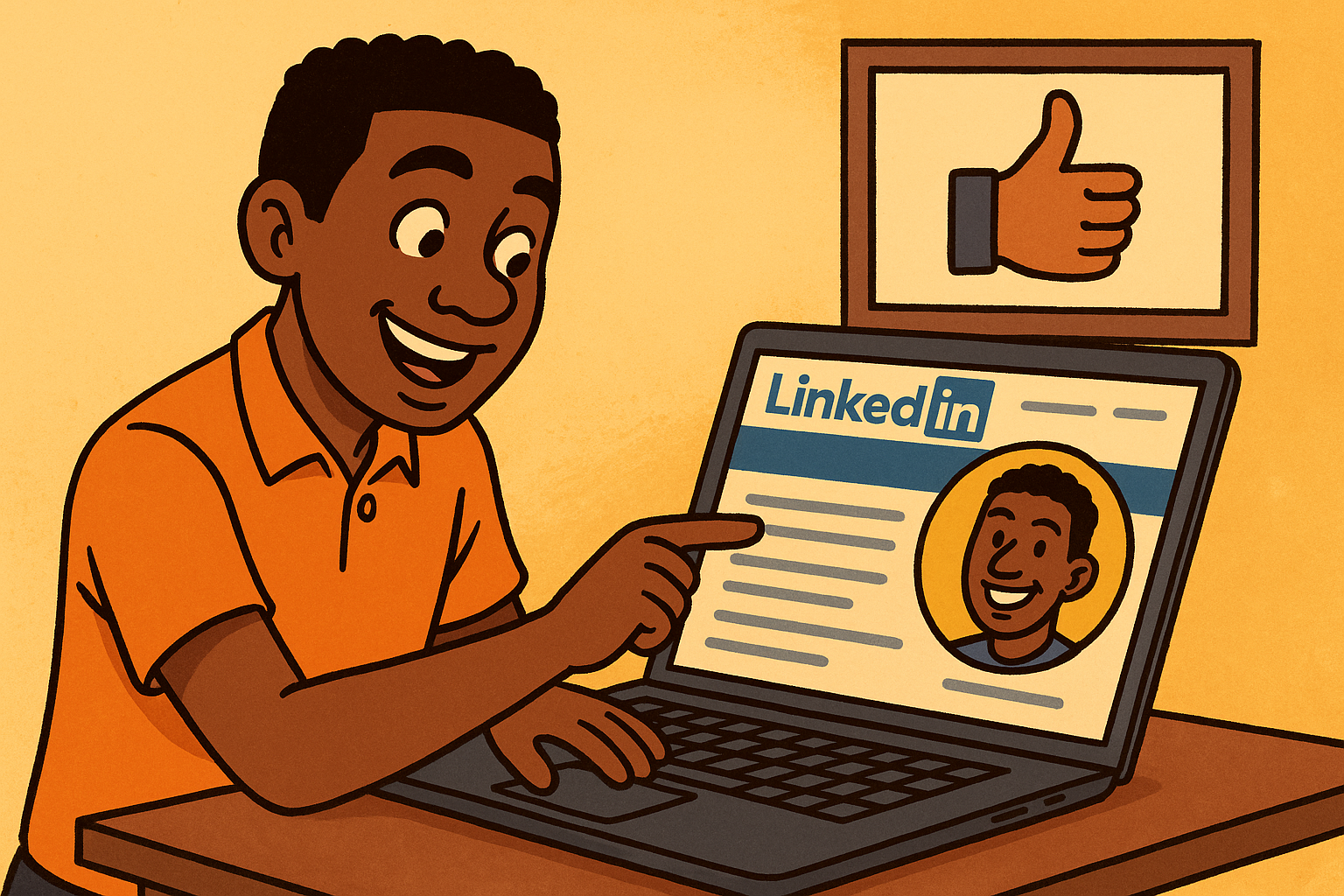
You know that feeling when you update your CV, send five applications, and… nothing happens? Sometimes it isn’t your skills—it’s your online presence. In South Africa today, recruiters and hiring managers often discover candidates through LinkedIn before ever seeing a CV. If your LinkedIn profile is weak, outdated, or generic, you’re leaving opportunities on the table.
But the solution isn’t to plaster it with buzzwords or chase vanity metrics. It’s about telling a genuine, strategic story of who you are, where you want to go, and proving it through evidence.
In this post, I’ll walk you through how to build a LinkedIn profile that stands out in the South African market: from choosing the right photo, to writing your summary to network strategy. I’ll share local examples, resources, and links so you can put this into action immediately.
Why LinkedIn matters in South Africa right now
In SA, job boards like PNet, Careers24, and Indeed are still widely used—but many recruiters also search LinkedIn directly for candidates. If your profile doesn’t show up, they might never come across you. LinkedIn has become a kind of live CV with social proof: endorsements, posts, mutual connections, shared content.
For professionals in Johannesburg, Cape Town, Durban, and more remote areas, LinkedIn offers a chance to be visible beyond local job ads. If you optimise your profile well, you can get approached first, rather than chasing adverts.
Also, many SA employers check whether your LinkedIn story aligns with your CV, during hiring or when deciding on shortlists. Discrepancies raise red flags.
So investing solid effort in a strong profile can deliver returns: more inbound recruiter messages, more visibility, better matches.
The foundations: photo, headline, and background
Your photo is your first handshake. Use a clean, professional headshot: good lighting, neutral or subtle background, dressed in attire appropriate for your field (not too casual unless that’s your industry). Eyes forward, reasonably smiling or approachable—don’t overdo expressions.
Behind your headshot, LinkedIn gives you a background/banner image. Use it. Choose something subtle but relevant—a skyline of your city, an abstract design that reflects your field (for example, if you’re in tech, maybe code or circuit motif), or something local (a subtle outline of Table Mountain or Joburg skyline, etc.). That background image gives breathing room and helps your profile look intentional.
Your headline matters more than people realise. Instead of just your job title, you can use: Title + value statement + specialisation. For example:
“Marketing Manager | Digital Campaigns for South African Startups | SEO & Content Strategy”
This shows who you are, what you bring, and where you do it (SA context). Avoid generic “looking for opportunities” or “Open to work” entirely in the headline—those can devalue first impressions.
Crafting a summary/about section that draws people in
This is where you tell your story. Imagine you’re talking to someone new over coffee in Pretoria. What would you say? You don’t need to chronicle your whole life—just enough to highlight the core of what you do, why it matters, and where you want to go next.
Begin with a hook: one line that captures your mission or your special strength. Then follow with a few short paragraphs: your key skills, successes, and what you’re excited to tackle next. End with a “call to connection”—invite people to message, connect, discuss, etc.
Be specific. Instead of saying “I’m a software developer,” say “I help SA fintechs build scalable APIs that handle 1M+ user requests per day.” Use numbers, project names, and results.
Also include a few keywords (but naturally). Don’t stuff with “hardworking, team player, self-motivated,” etc. Use terms recruiters actually search for in your field (e.g. “data engineer,” “RPA,” “digital marketing,” “UI/UX,” “compliance,” etc.)—but only if they apply to you.
One more trick: add a personal touch, such as “In my free time, I mentor underrepresented youth in coding bootcamps” or “I’m learning Zulu to better communicate with clients in rural areas.” That humanises you.
Experience, projects, and proof
Your experience section must do more than list job titles. For each role, include 2–4 short paragraphs (or bullet-style sentences in prose form) summarising:
-
What problem did you tackle
-
What action did you take
-
What outcome did you achieve
Use metrics where possible (e.g. “reduced lead time by 30%,” “grew LinkedIn content reach from 2,000 to 15,000 in six months,” etc.). If the project was for a local company or brand, mention its name to give context.
If you have side gigs, freelance, volunteer work, open source projects—list them too. Those can help fill gaps and show breadth. For example you helped a local NPO build their website, or you did a digital marketing campaign for a community initiative. That adds trust and shows initiative.
Also attach media where possible: slide decks, PDF reports, images, websites you built etc. A recruiter browsing your profile will see that you back claims with evidence.
Skills, endorsements, and endorsements strategy
Add relevant skills—but don’t go overboard. Pick 10–15 that truly reflect what you want to be known for. LinkedIn lets you re-order them—put the top 3 that are most aligned with the roles you want high up.
Endorsements help, but they are weaker than they once were. What’s more credible is that your connections back you for skills—and that people you’ve worked with write recommendations.
Ask for recommendations (short ones are fine) from past colleagues, managers, clients—especially the ones who can speak to results. A few lines about your impact make more difference than many “nice words.” Recommendations are proof that you can deliver.
Also, endorse others genuinely. If you endorse former coworkers or peers (when you actually know their work), many will reciprocate. This gently increases visibility.
Networking the right way (connecting, posting, engagement)
Your profile is the foundation—but the real engine is how you use it. Don’t just connect randomly—connect with people you meet, people in your sector, HR professionals, thought leaders, people in SA.
When sending a connection request, always include a short note. Something like:
“Hi X, I saw your post about [topic]. I’m working in digital marketing in Pretoria and would love to connect and hear more about your work.”
Once connected, engage: comment on their posts, share relevant articles, ask questions. Show interest deeper than “nice post.”
Post your own content too. Share insights, case studies, and lessons learned. Even small posts (“I just improved our team’s internal process, here’s how”) build presence. Try to do this a couple of times a month. Tag people when relevant (if they contributed) and use hashtags suited to your field (and SA audience).
Participate in LinkedIn groups or South African forums (e.g. groups for SA developers, SA marketers, niche interest groups). Ask and answer questions. Visibility grows with helpfulness.
Keywords, SEO, and discoverability
To help you show up in recruiter searches, include terms in your profile that people are likely to search. Use your core skills, tools, certifications, industry terms, and regional markers (like “South Africa,” “Cape Town,” “Johannesburg,” or “SA”). But be natural—don’t force random terms.
Also, in your experience and summary, variations and synonyms help. For example, if you’re a “data analyst,” also mention “data insights,” “business intelligence,” or “Power BI” if applicable.
Be consistent with spelling: e.g. “programme management” vs “program management.” The variant recruiters use matters.
Finally, update your profile often (minor tweaks count): LinkedIn gives weight to recent updates. Even changing a phrase shows you’re active.
Common mistakes to avoid
Don’t leave blank sections. Every section you can fill should be filled—education, certifications, volunteering. Even gaps are okay if you explain them (e.g. sabbatical, travel, upskilling).
Avoid overused, vague buzzwords like “dedicated, motivated, results-oriented.” These tell nothing. Show your results instead.
Don’t set your profile visibility so low that recruiters can’t see you.
Don’t accept every connection blindly—spam or irrelevant networks dilute the signal.
Don’t publish things outside your field that clash with your brand. If you’re doing finance, random meme posts about politics might confuse viewers.
Don’t forget to proofread—typos, broken links, errors kill credibility.
Final checklist & next steps
Once you’ve updated your profile with all the above, you’re not done. Use the momentum:
-
Reach out to two people you’d like to connect with in your field, with a warm message.
-
Ask one former colleague or manager for a recommendation.
-
Share a short post or insight this week (even 3–4 sentences).
-
Monitor who views your profile, who follows, and adjust keywords or phrases if you don’t get traction.
-
Keep refining—update as you complete new projects or learn new skills.
Over a few weeks, as you use LinkedIn actively and align your profile with your lived experience, you’ll start getting more recruiter messages, more profile views, and better alignment with the roles you want.
Related posts:



LEGAL CONTENT DISCLAIMER
The information contained on this website is simply aimed at providing readers with guidance on labour law in South Africa. This information has not been provided to meet the individual requirements of a specific individual. Bizcraft will always suggest that legal advice be obtained to address a person’s unique circumstances. It is important to remember that the law is constantly changing and although Bizcraft strives to keep the information up to date and of high quality, it cannot be guaranteed that the information will be updated and/or be without errors or omissions. As a result, Bizcraft will under no circumstances accept liability or be held liable, for any innocent or negligent actions or omissions which may result in any harm or liability flowing from the use of or the inability to use the information provided.