Updated: May 2026 | Sources: SABRIC, SAPS, Africa Check, UNODC, INTERPOL, EWN, National Human Trafficking Hotline, National Freedom Network | Share this with someone you care about. It could save them.
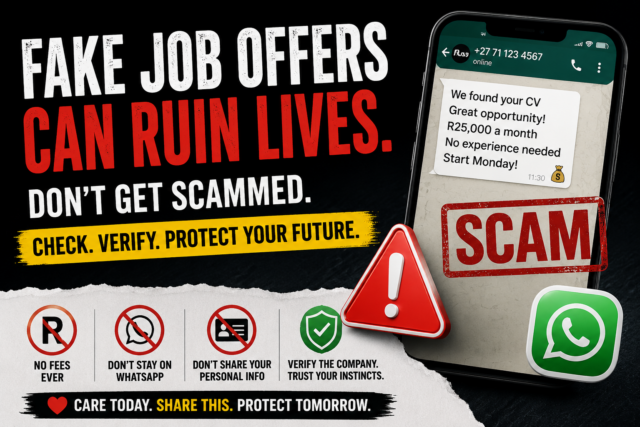
Before you read anything else: South African job seekers are being trafficked overseas through fake WhatsApp and Facebook job offers. This is not a theoretical risk. As of May 2026, South Africans are among confirmed victims rescued from scam compounds in Myanmar, Cambodia, and Laos, where they were forced to work as online fraudsters under threat of violence. The National Freedom Network warns that the problem is under-reported and growing. The National Human Trafficking Hotline is 0800 222 777, available 24 hours a day, free, and confidential.
South Africa has 28.8 million WhatsApp users. It has one of the highest Facebook penetration rates in Africa. And it has an unemployment rate sitting above 31%. Put those three things together and you have a scammer’s dream: millions of desperate, digitally connected job seekers who can be reached instantly, at almost no cost, with a fake job offer that looks real enough to act on.
The scams range from mildly annoying to life-destroying. At the lower end: you waste a morning, hand over your ID number, and never hear from ‘the recruiter’ again. At the upper end: you board a flight to Southeast Asia for a job that does not exist and end up locked in a compound, your passport confiscated, forced to run online scams for criminal networks while your family in South Africa has no idea what happened to you.
This is not exaggeration. This is what is happening right now, documented by UNODC, INTERPOL, and reported in South African news in 2025 and 2026. The people it happens to are not naive. They are job seekers, just like millions of other South Africans. The only difference is that nobody showed them what these scams actually look like before they encountered one.
This article does that. Share it.
Real Job vs Scam: The Side-by-Side Checklist
Screenshot this table. Save it. Send it to your family WhatsApp group right now before you read the rest. It is the fastest way to check any job offer that comes through your phone.
| ✅ A REAL JOB OFFER… | ❌ A SCAM OFFER… |
| Comes from a company email address (name@companyname.co.za) | Comes from a Gmail, Yahoo, Outlook, or WhatsApp number with no company email |
| Names the company clearly — you can Google it and find an actual website and office address | Uses a vague company name or impersonates a real well-known brand |
| Was applied for by you, or references a specific platform where you posted your CV | Contacts you out of nowhere claiming they ‘found your CV in a database’ |
| Offers a salary appropriate to the role, experience, and industry | Promises unusually high pay for minimal experience or unclear work |
| Asks you to apply or interview through an official process (email, formal platform, video call) | Keeps everything on WhatsApp, Facebook Messenger, or Telegram |
| Has a formal written offer letter on company letterhead before you start | Rushes you toward signing something quickly or verbally confirms ‘you got the job’ |
| Charges you nothing — the employer pays you | Asks for any fee: registration, placement, admin, uniform, background check |
| Asks for personal documents after a formal offer, with clear explanation and HR process | Requests your ID, banking details, and address before you have even met anyone |
| Can be verified: a real person, a real address, a real phone number that rings at an office | Becomes vague or defensive when you ask basic questions about the company |
| Is patient — they want to hire the right person | Creates urgency: ‘You must accept today’ or ‘Only 3 spots left’ |
01 📲 THE ‘WE FOUND YOUR CV’ WHATSAPP MESSAGE
It arrives out of nowhere. Your phone buzzes. Someone wants to offer you a job.
You did not apply anywhere. But a message arrives — sometimes professional-looking, sometimes informal — saying they found your CV on PNet, Careers24, or LinkedIn, and they have the perfect opportunity for you. The salary is good. The role sounds legitimate. All they need is a few details to get the ball rolling.
How it works: The scammer scrapes CVs from job platforms or buys contact lists. They send bulk WhatsApp messages to thousands of numbers. Most ignore them. But when you are unemployed and worried, that message hits differently. You respond. They get personal. They request your ID number, home address, and banking details for a ‘background check.’ Then one of three things happens: they vanish with your data, they ask for a fee, or they set up a fake interview to get more from you.
The red flags: You did not apply. The salary is vague or suspiciously high. Everything stays on WhatsApp. The number is a personal cell, not a company line. They ask for personal documents before any formal process begins.
Real case: In 2025, Africa Check documented multiple viral Facebook posts claiming Shoprite, Mr Price, Spar, and Pep were hiring — using official logos and branding stolen from the real companies. Thousands of South Africans engaged. The posts directed applicants to WhatsApp numbers. The companies had nothing to do with any of it.
What to do: Do not respond to unsolicited WhatsApp job messages. Do not share your ID, banking details, or address with anyone you have not verified through an official company process. If the offer sounds real, go directly to the company’s official website and apply through their careers page.
02 💵 THE FEE-TO-START SCAM
Real employers pay you. The moment someone asks you to pay them, the job does not exist.
You have been through the ‘interview.’ You have been told you are perfect for the role. You are excited. And then — the kicker. Before you can start, you need to pay a small fee. Registration fee. Placement fee. Admin fee. Background check fee. Uniform fee. Training materials. It varies. The amount is always ‘small’ relative to the salary on offer. R350 to get a R20,000-a-month job sounds like a good trade. Until you pay it and discover there is no job.
How it works: The scammer builds trust first — a convincing fake interview, professional-sounding messages, sometimes even a fake ‘offer letter’ on stolen company letterhead. Then they introduce the fee at the moment of maximum excitement, when you have already emotionally committed to the job. If you pay, they often ask for more (‘the background check took longer than expected, there’s an additional R200’). This is called ‘pig butchering’ — slowly escalating demands from a victim who has already invested.
The red flags: Any fee before you start working. A fee framed as a deposit that will be refunded. Payment requested via SnapScan, EFT to a personal account, eWallet, or cash. The fee is always ‘small’ relative to the promised salary.
Real case: SETA impersonation scams have proliferated since 2024. Job seekers are told they have been ‘accepted’ for a SETA-funded learnership and must pay a R450 registration fee. SETAs never charge candidates to register. Ever. If someone claiming to be from a SETA asks for money, it is a scam.
What to do: Never pay any fee to get a job. If any employer — local or overseas, SETA or private company — asks for money before you start working, the job does not exist. Report the number to SAPS and block it.
03 🏦 THE IDENTITY THEFT JOB APPLICATION
They do not want your labour. They want your ID number, your bank details, and your proof of address. That is the product.
This scam looks exactly like a legitimate application process — right up until the point where it asks for things no employer needs before you have been offered a job. Your full ID number, your banking details, your home address, a copy of your ID book, your proof of residence. ‘Standard HR process,’ they say. ‘We need to start your background check.’ And then they disappear. With everything they need to open accounts, take out loans, apply for credit, or drain your bank account in your name.
How it works: Scammers specifically design this scam to look like professional recruitment. They use company logos, formal language, and sometimes even conduct a fake video interview to build credibility before the document request. The goal is always the same: collect enough personal information to commit identity fraud, or sell your data to other criminals.
The red flags: Asked for banking details before a job offer exists. Asked for ID and proof of residence before you have even met anyone in person. The request comes via WhatsApp or a personal email rather than an official HR portal or company email address. The ‘background check’ happens very early in the process.
Real case: The South African Banking Risk Information Centre (SABRIC) confirmed in 2025 that fake job applications have become one of the primary vectors for personal information theft. Victims often only discover the fraud weeks later when unexpected credit accounts appear or their bank contacts them about suspicious transactions.
What to do: Never share your banking details, full ID number, or certified documents with anyone you have not verified through the company’s official process. Legitimate companies conduct background checks after a formal written offer has been accepted — not during the application stage.
04 🏢 THE FAKE COMPANY FACEBOOK PAGE
The logo is real. The address is real. The phone number rings. The job is not.
This is the most sophisticated local scam. Someone creates a Facebook page that is a near-perfect copy of a real South African company — Shoprite, Pick n Pay, Capitec, Multichoice, Discovery. They use the real logo, the real colours, real photos scraped from the genuine page. They post a job ad. Thousands of people engage — because it looks completely legitimate. The only difference from the real page is the URL, which is slightly wrong: ShopriteCareers instead of Shoprite, or DiscoveryHoldings-Careers instead of Discovery.
How it works: When you apply through the fake page, you are directed to a WhatsApp number or a cloned website. Everything that follows — the interview, the offer, the fee request, the document collection — is the scam. The real company has no idea any of this is happening under their brand.
The red flags: A Facebook jobs page with very few followers despite a famous brand name. The page was created recently (check Page Transparency). Links to WhatsApp rather than an official company website. The company’s official website has no mention of the vacancy. Slight differences in the page name or URL.
Real case: Africa Check’s 2024 and 2025 investigations documented dozens of fake pages impersonating major South African retailers and banks. In one case, a fake Shoprite page accumulated over 5,000 shares of a single fake job post before it was reported and taken down.
What to do: Always find the company’s official Facebook page by going to their real website and clicking the social media link. Do not follow links from job posts — go directly to the source. If the job is real, it will appear on their official website’s careers page.
05 🌍 THE OVERSEAS JOB OFFER THAT IS ACTUALLY HUMAN TRAFFICKING
This is the one that ends careers. And lives. Read this section twice.
The offer is compelling. Customer service role in Southeast Asia. Digital marketing position in the Middle East. IT support in Thailand. The salary is in US dollars. Flights and accommodation are included. All you need to do is get a visa and show up. It sounds like the break you have been waiting for. It is not. In documented cases reported by EWN, the National Freedom Network, and UNODC, South Africans who accepted these offers arrived at their destination to find that the job did not exist — and that they were now inside a heavily guarded compound with their passport confiscated.
How it works: These operations are run by organised crime networks operating primarily in Myanmar, Cambodia, Laos, and the Philippines, with expanding operations in the Middle East and West Africa. Victims are forced to work as online scammers — running romance fraud, crypto investment scams, and fake job scams on other victims around the world. UNODC confirmed that South Africans are among survivors interviewed from these compounds. INTERPOL reported in 2025 that victims from 66 countries had been trafficked into these operations, with African recruitment expanding rapidly.
The red flags: An overseas job that came through WhatsApp or Facebook from someone you do not know. Flights and accommodation included with no formal employment contract. The company cannot be verified through official channels. The destination is Southeast Asia, the UAE, or West Africa. You are told to keep the opportunity quiet. The urgency is extreme: ‘You must decide within 48 hours.’
Real case: In October 2025, EWN reported dozens of South Africans stranded in Myanmar after a fake job offer turned into a human trafficking nightmare. A Cape Town gardener was documented to have signed a contract he could not understand, believing it was a driver’s job. He ended up at the frontlines of a conflict zone. As of May 2026, EWN reports that South Africans continue to be rescued from cyberscam compounds in Southeast Asia. The National Freedom Network’s Joseph Mogoshane said the problem is severely under-reported because victims are ashamed and families do not know who to call.
What to do: If someone you do not personally know offers you an overseas job via WhatsApp or Facebook with flights included, treat it as a potential trafficking situation. Do not go. Report it to the National Human Trafficking Hotline: 0800 222 777, free, 24 hours, confidential. If you are already overseas and in danger, contact the South African Embassy in the relevant country and call the hotline from any available phone.
06 🎓 THE FAKE SETA LEARNERSHIP
They use the government’s name. They target the most vulnerable job seekers. And they are lying.
A WhatsApp message or Facebook post announces that a SETA is accepting applications for a funded learnership. The salary is R5,000 to R8,000 per month. It is aimed at unemployed youth. No experience required. You just need to register on a link and pay a small administrative fee. The SETA branding looks official. The language matches what real SETA communications look like. And thousands of young South Africans, who genuinely need the opportunities that SETA learnerships provide, respond.
How it works: This scam exploits the real, legitimate world of SETA-funded learnerships — which are genuine, valuable, government-funded programmes that pay stipends to unemployed youth. The scammers copy the branding of real SETAs (MICT SETA, W&R SETA, SERVICES SETA, ETDP SETA) and create convincing fake applications. The fee is the core of the scam, but collecting personal data for identity fraud is an additional objective.
The red flags: A fee of any kind. Real SETA learnerships never charge candidates. A WhatsApp number as the contact point rather than a verifiable government email address. The link directs to a non-government website. The SETA’s official website has no matching vacancy.
Real case: MICT SETA and W&R SETA both issued official scam warnings in 2024 and 2025 after fake learnership posts using their names went viral on Facebook. The fake posts offered IT learnerships and retail learnerships respectively, directing applicants to WhatsApp numbers and requesting a R350 ‘registration fee.’
What to do: Find the real SETA for your sector by visiting seta.co.za or the individual SETA’s official government website. Apply directly through the official government channels or through SAYouth.mobi. SETAs never charge registration fees. Report fake SETA posts to the real SETA’s communications department and to SAPS.
07 👤 THE FAKE LINKEDIN RECRUITER
They steal real people’s identities. They build credibility over weeks. Then they strike.
This is the most patient and most professional of all job scams. A recruiter connects with you on LinkedIn. Their profile looks completely legitimate — professional photo, work history, recommendations, hundreds of connections. They engage with your content. They send a friendly message. They build a relationship over weeks. And then, when you trust them completely, they present you with an opportunity that involves a fee, a document request, or an overseas offer.
How it works: Scammers create fake LinkedIn profiles using photos stolen from real recruiters — sometimes from international HR professionals who have no idea their identity is being used. Africa Check’s 2026 scam trend guide noted the rapid growth of AI-assisted identity fraud, where scammers use AI tools to create more convincing fake profiles. The long lead-up is intentional: every week of friendly interaction makes the eventual ask harder to refuse.
The red flags: The profile photo appears elsewhere under a different name (reverse image search). The profile was created or substantially updated recently. The recruiter becomes vague when asked specific questions about their company or the role. The opportunity eventually involves a fee, a document request, or an overseas placement.
Real case: An X (Twitter) user documented in January 2026 that a scammer had used his real photos to create a fake recruitment profile and had already solicited money from multiple victims. He only discovered it when a victim contacted him directly. Africa Check confirmed this pattern is increasingly common in South Africa.
What to do: Always reverse image search a recruiter’s profile photo. Verify their company on the company’s official website. Move the conversation from WhatsApp to official email immediately. If they resist providing a company email address, that is your answer.
How to Verify Any Job Offer in 7 Steps
Before responding to, applying for, or paying anything related to any job offer that comes through WhatsApp or Facebook, run through this checklist:
| Check | How to Do It | What a Scam Looks Like vs Reality |
| Google the company name | Search the exact company name. Check the first page of results carefully. | Real company: has a website, news coverage, a LinkedIn page, and reviews. Scam: one fake Facebook page, no website, or results that match a completely different company. |
| Reverse image search the recruiter’s profile photo | On Google Images, click ‘Search by image’ and upload the recruiter’s photo from LinkedIn or Facebook. | Real recruiter: photo matches their LinkedIn profile consistently across platforms. Scammer: same photo appears under multiple names, or on stock photo sites, or on scam warning pages. |
| Verify the email domain | Look at the part after the @ symbol. Does it match the company website exactly? | Real email: john@abcconsulting.co.za and the website is abcconsulting.co.za. Scam email: john@abcconsulting-recruitment.gmail.com or john@abcconsulting.net (different domain). |
| Call the company’s main switchboard | Find the company’s main phone number on their official website (not from the recruiter). Call and ask to speak to the HR department. | Real company: HR confirms the vacancy and the recruiter’s name. Scam: number doesn’t exist, goes to a personal cell, or the ‘company’ has never heard of the vacancy. |
| Check for the company on CIPC | Go to eservices.cipc.co.za and do a company name search. | Real company: registered on CIPC with a verifiable registration number. Scam: either not registered or registered very recently (days or weeks ago). |
| Search the company name + ‘scam’ or ‘fraud’ | Type: [Company name] scam South Africa — into Google. | Real company: no results or news about scam warnings. Scam: multiple warning posts, Hellopeter complaints, or consumer alert pages. |
| Check their Facebook or LinkedIn page creation date | On Facebook: About > Page transparency > See all > shows when the page was created. On LinkedIn: About > shows ‘Founded’. | Real company: page created years ago, consistent history of posts. Scam: page created days or weeks ago, very few followers, posts only about job vacancies. |
What to Do If You Have Already Been Scammed
First: do not be ashamed. These scams are sophisticated. They are designed by people who do this full-time and who specifically target the exact emotional state you were in. You were not stupid. You were targeted.
If you shared personal documents (ID, banking details, proof of address): Contact your bank immediately. Ask them to place a fraud alert on your account and monitor for suspicious transactions. Report to SABRIC at 011 847 3000. Place a fraud alert with the credit bureaus — TransUnion (0861 886 466) and Experian South Africa (0861 105 665) — to prevent accounts being opened in your name.
If you paid a fee: Report to SAPS at your nearest police station. Get a case number. Report to SABRIC. If the payment was by EFT, contact your bank immediately — in some cases transfers can be reversed if reported quickly enough. The chances of recovering the money are low, but reporting creates a paper trail that helps build cases against serial scammers.
If you are overseas and in danger: Call the South African Embassy in the country you are in. Contact the National Human Trafficking Hotline: 0800 222 777. If you cannot make a call, text a trusted person in South Africa with your location and ask them to call on your behalf.
If you were not financially harmed but want to help others: Report the scam on Facebook (use the three-dot menu on any post or profile to report). Share your experience — carefully and without personal identifying details — in community groups. Every warning that reaches someone before they encounter the scam matters.
Where to Report Job Scams in South Africa
| Where to Report | Contact Details | What They Handle |
| South African Police Service (SAPS) | Your nearest police station, or 10111 | Fraud, identity theft, any criminal element of job scams. Always report — even if nothing was taken. Creates a record. |
| South African Banking Risk Information Centre (SABRIC) | sabric.co.za | 011 847 3000 | If you shared banking details or money was taken from your account. SABRIC works with banks to investigate and recover funds. |
| Department of Employment and Labour | 0800 030 007 (toll-free) | Fake recruitment agencies operating without registration. Employers who violate labour law under the guise of employment. |
| National Human Trafficking Hotline | 0800 222 777 (free, 24/7) | If the scam involves an overseas job offer or you believe someone may have been trafficked. Anonymous and confidential. |
| South African Human Trafficking Foundation | humantrafficking.org.za | Support, information, and referrals for trafficking-related job scams. |
| Recruitment industry regulator — APSO | apso.co.za | If a registered recruitment agency is involved in fraudulent conduct. APSO can investigate and discipline member agencies. |
| Facebook / Meta | facebook.com/help — report the post or profile directly | Fake Facebook job posts, fake company pages, scam adverts. Meta’s reporting system can remove content and ban accounts. |
| Internet Crimes Against Children / SAPS Commercial Crimes Unit | Via SAPS 10111 | Online fraud, digital crimes, identity theft from job scams involving minors or large-scale operations. |
Where to Find Real Jobs in South Africa
The safest way to protect yourself from job scams is to only look for work through verified, reputable platforms where employers are screened and accounts are verified. If a job opportunity comes to you through WhatsApp or Facebook from someone you don’t know — rather than from a platform where you chose to be listed — treat it with extreme suspicion.
- PNet (pnet.co.za): South Africa’s largest job portal. Employers are verified. Apply directly through the platform.
- Careers24 (careers24.com): Broad coverage, screened employers. Apply through the platform, not via WhatsApp.
- LinkedIn Jobs (linkedin.com/jobs): Verify every recruiter independently before engaging off-platform.
- Indeed South Africa (za.indeed.com): Large aggregator. Check that each posting links to the company’s real website.
- SAYouth.mobi: Government-operated platform for youth. Zero-rated on major networks. All listings verified.
- DPSA Vacancy Circular (dpsa.gov.za): Official government jobs. Free. Published every Friday. Never requires a fee.
- GPG Professional Job Centre (jobs.gauteng.gov.za): Gauteng government jobs. Free. Official portal.
- Company websites directly: Find the careers page of companies you want to work for. Apply there.
The Most Important Thing
Job scams in South Africa are not going away. With unemployment above 31% and WhatsApp in the hands of nearly everyone, the conditions that make these scams possible are not changing. What can change is how many people know what to look for before they encounter one.
If you read this article and recognised a scam you are currently in, stop now. Do not pay anything else. Do not share any more information. Contact SAPS, your bank, and the National Human Trafficking Hotline if there is an overseas element.
If you read this and nothing happened to you — share it. Put it in your family group. Send it to the friend who is currently job hunting. Post it on your Facebook page. The person who needed to read this most is probably not the one sitting here right now. They are somewhere else, phone in hand, looking at a message that says ‘We found your CV in our database.’
They need this before they reply.
Emergency numbers to save right now: National Human Trafficking Hotline: 0800 222 777 (free, 24/7, confidential) | SAPS: 10111 | SABRIC: 011 847 3000 | Department of Employment and Labour: 0800 030 007
Related posts:




LEGAL CONTENT DISCLAIMER
The information contained on this website is simply aimed at providing readers with guidance on labour law in South Africa. This information has not been provided to meet the individual requirements of a specific individual. Bizcraft will always suggest that legal advice be obtained to address a person’s unique circumstances. It is important to remember that the law is constantly changing and although Bizcraft strives to keep the information up to date and of high quality, it cannot be guaranteed that the information will be updated and/or be without errors or omissions. As a result, Bizcraft will under no circumstances accept liability or be held liable, for any innocent or negligent actions or omissions which may result in any harm or liability flowing from the use of or the inability to use the information provided.