The Most Misunderstood Part of a Job Application
Ask most job seekers what they think about cover letters and you will get one of two responses. Either “I never bother with them” or “I write the same one every time and just change the company name.”
Both of these approaches are missed opportunities, and they are more common than you might think.
A cover letter, when done well, is one of the most powerful tools you have in your job search. It is your chance to speak directly to the employer in your own voice, to explain why you want this specific job at this specific company, and to give context to things that a CV simply cannot convey. It is the difference between handing someone a list of facts about yourself and actually having a conversation with them.
Now, it is true that not every employer reads cover letters. Some job portals do not even have a field for them. But when a cover letter is requested, or when there is an opportunity to include one, ignoring it is a mistake. A good cover letter can tip a borderline application into the shortlist pile. And in a competitive job market like South Africa’s, you want every possible advantage working in your favour.
This article is going to show you exactly what a great cover letter looks like, how to structure it, what to say, and just as importantly, what not to say.
What a Cover Letter Is Not
Before we get into how to write a good one, let us clear up some very common misconceptions.
A cover letter is not a summary of your CV. If you simply repeat what is already in your CV, you are wasting the reader’s time and your own. They can read your CV. The cover letter should add something new.
A cover letter is not a list of why you need the job. “I am a hard worker and I really need this opportunity to support my family” is not a cover letter. Employers are not hiring you to do you a favour. They are hiring you to solve a problem for them. Your cover letter needs to show them that you understand their problem and that you are the right person to help solve it.
A cover letter is not just a formality. When treated as a box to tick, it reads that way. The employer can tell immediately when someone has not put any real thought into their letter, and it reflects poorly on the application as a whole.
A cover letter is a professional, personalised introduction that makes the employer want to read your CV and invite you in for an interview. That is its one job, and everything in it should serve that purpose.
How Long Should a Cover Letter Be?
Short. Focused. To the point.
A cover letter should fit comfortably on one page. Three to four paragraphs is the sweet spot. If you are going beyond that, you are including too much. Employers are busy people. A concise, well-written letter shows that you respect their time and that you can communicate efficiently, which is itself a desirable quality in any employee.
The Structure of a Great Cover Letter
Here is a simple, effective structure that works for almost any job application.
Opening: Your Header and Greeting
At the top of your cover letter, include your name and contact details, the date, and the name and address of the company you are writing to. This follows the same format as a formal business letter.
If you know the name of the person who will be reading your application, use it. “Dear Ms Dlamini” or “Dear Mr Van der Merwe” is far better than “Dear Sir/Madam” or “To Whom It May Concern.” Taking the time to find out who to address the letter to shows initiative and attention to detail. Check the job advertisement, the company website, or even LinkedIn to find the right name.
If you genuinely cannot find a specific name after a reasonable effort, “Dear Hiring Manager” is an acceptable alternative.
Paragraph 1: The Opening Hook
Your first paragraph needs to do two things. It needs to tell the employer what position you are applying for, and it needs to give them a reason to keep reading.
Most cover letters open with something like this:
“I am writing to apply for the position of Marketing Coordinator as advertised on Careers24.”
This is fine. It is clear. But it is also completely forgettable. Try to make your opening a little more engaging without being over the top. Here are two examples that do this well.
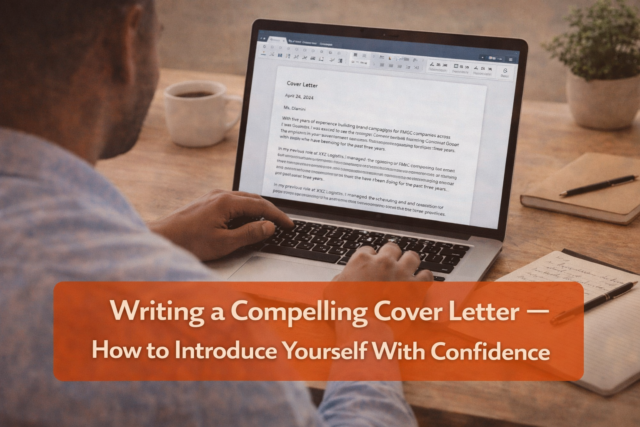
“With five years of experience building brand campaigns for FMCG companies across Gauteng, I was excited to see the Marketing Coordinator role at ABC Consumer Goods. The emphasis in your advertisement on digital-first strategy and data-driven decision making aligns directly with the work I have been doing for the past three years.”
Or for someone less experienced:
“I recently completed my National Diploma in Business Administration at Tshwane University of Technology, and I have been following ABC Company’s growth in the logistics sector with genuine interest. When I saw your administrative assistant vacancy, I knew immediately that this was the kind of environment where I want to start my career.”
Both of these openings are specific, they mention the role and the company, they give a quick sense of who the applicant is, and they create a natural reason to keep reading.
Paragraph 2: Why You Are the Right Person for This Role
This is the heart of your cover letter. Here you connect your most relevant skills and experience directly to what the employer is looking for.
Go back to the job description and pick the two or three most important requirements. Then show, briefly and specifically, how you meet them. Use real examples where you can.
“In my previous role at XYZ Logistics, I managed the scheduling and coordination of a team of twelve drivers across three provinces, reducing late deliveries by 18 percent over a twelve-month period. I am comfortable working under pressure and I understand the importance of clear communication and accurate record-keeping in a fast-moving operational environment, both of which your advertisement highlights as key requirements.”
Notice what this paragraph does. It names a real achievement with a real number. It connects that achievement to what the employer specifically mentioned. And it does it in just a few sentences. That is efficient and impressive.
If you have limited formal work experience, focus on transferable skills, relevant training, and any practical examples you have, even from volunteer work, academic projects, or part-time jobs.
Paragraph 3: Why You Want to Work for This Specific Company
This paragraph is where most cover letters fall completely flat. Most applicants skip it entirely, or they write something so generic it might as well not be there.
But this paragraph, when done well, is what separates a truly compelling cover letter from an average one. Because it shows the employer that you are not just looking for any job. You are looking for this job, at this company. And that kind of genuine interest is something employers genuinely value.
To write this paragraph well, you need to do a small amount of research on the company. Visit their website. Read their “About Us” page. Look at recent news about them. Check their social media. Find something that genuinely resonates with you, whether it is their values, their approach to their work, their reputation in the industry, a recent project or initiative, or simply the kind of work they do.
Then mention it specifically.
“I have admired Greenfield Construction’s commitment to sustainable building practices for some time, particularly the work you have done on the Cape Town waterfront development. The idea of contributing to projects that have a lasting positive impact on communities is something I feel strongly about, and it is a significant reason why this role appeals to me beyond the job description alone.”
You do not need to write an essay. Two or three sentences that show you actually know something about the company and that you are genuinely interested in being part of what they do will stand out strongly against the sea of generic applications they receive.
Paragraph 4: The Closing
Keep your closing short and confident. Thank the reader for their time, express your enthusiasm for the opportunity to discuss your application further, and let them know how to reach you.
“Thank you for taking the time to consider my application. I would welcome the opportunity to discuss how my experience and approach could contribute to the team at ABC Company. I am available at your convenience and can be reached on 082 000 0000 or at firstname.lastname@gmail.com.”
End with a professional sign-off. “Yours sincerely” is appropriate if you have addressed the letter to a named person. “Yours faithfully” is technically correct if you used “Dear Hiring Manager.” In practice, either is fine.
Tone: How to Sound Like a Human Being
One of the biggest challenges with cover letters is striking the right tone. You want to sound professional, but not robotic. Confident, but not arrogant. Enthusiastic, but not desperate.
The simplest way to get the tone right is to write the way you would speak in a professional setting. Not the way you speak with your friends on a Saturday afternoon, but not stiff and formal either. Imagine you are sitting across a desk from the hiring manager and you are explaining why you are applying. What would you actually say?
Read your cover letter out loud once you have written it. If any sentence sounds strange or unnatural when you say it, rewrite it. Your cover letter should feel like it came from a real person, because it did.
Common Cover Letter Mistakes to Avoid
Starting every sentence with “I.” This is a very common habit and it makes the letter feel self-centred. Vary your sentence structure and try to keep the focus on what you can offer the employer, not just on what you want.
Copying phrases directly from the job advertisement back into your letter without adding anything. You need to go beyond the job description, not just echo it.
Being too humble or too apologetic. Phrases like “I know I may not have all the experience you are looking for, but…” or “I am just a recent graduate, however…” are self-defeating. Lead with what you have, not what you lack.
Being overly familiar or casual. Avoid opening with “Hey!” or “Hi there!” No matter how friendly the company’s tone seems to be, your initial application is still a professional document.
Forgetting to proofread. Spelling mistakes and grammatical errors in a cover letter are especially damaging because this is a document you have written specifically for this application. Unlike a CV, which you might update infrequently, a cover letter is fresh. Errors in it suggest carelessness. Read it carefully. Read it again. Then ask someone else to check it.
Making it all about what you want rather than what you can offer. Remember, the employer’s primary question is “What can this person do for us?” Make sure your letter answers that question clearly.
A Simple Template to Get You Started
If you are not sure where to begin, here is a simple framework you can adapt:
Paragraph 1: State the role you are applying for, where you saw it advertised, and a brief, specific reason why it caught your attention.
Paragraph 2: Describe your most relevant experience or skills and connect them directly to the requirements in the job description. Use a specific example or achievement if you can.
Paragraph 3: Say something genuine and specific about the company that shows you have done your research and that you are interested in them in particular, not just any employer.
Paragraph 4: Thank the reader, express interest in discussing your application, and provide your contact details.
That is it. Four paragraphs. One page. Clear, specific, and human.
The Cover Letter That Actually Gets Read
A cover letter that follows this structure, that is tailored to the specific role, that speaks directly to what the employer needs, that shows genuine interest in the company, and that is written in a clear and natural voice, is a genuinely powerful document.
Most of your competition will not write one like this. They will copy and paste a generic paragraph, change the company name, and move on. That means the bar is not as high as you might think. A cover letter that shows real thought and real effort will stand out simply by being what most others are not.
Take the time to do it properly. It is worth it.
Before You Move On, Complete These Steps
This is where your application becomes personal. A strong cover letter can set you apart immediately, but only if you actually write one properly.
- Select a Job to Work With
Use the same job you used in the previous article or choose a new one you would realistically apply for. - Research the Company
Spend at least 10 to 15 minutes:- Visit the company website
- Read the “About Us” section
- Note something specific about the company that stands out
- Find the Right Contact Name
Try to identify who to address the letter to:- Check the job ad
- Search LinkedIn
- Use “Dear Hiring Manager” only if necessary
- Write Your Opening Paragraph
Include:- The job you are applying for
- A short, engaging reason why it caught your attention
- Write Your Main Paragraph (Your Value)
Focus on:- 2 to 3 key requirements from the job description
- Your relevant experience or skills
- At least one specific example or achievement
- Write Your Company Paragraph
Explain:- Why you want to work for this company specifically
- What you admire or connect with
- Write Your Closing Paragraph
Include:- A short thank you
- Your interest in discussing the role
- Your contact details
- Review Your Tone
Read your letter out loud and make sure:- It sounds natural and professional
- It does not sound copied or robotic
- Proofread Carefully
Check for:- Spelling and grammar errors
- Correct company name and job title
- Save Your Cover Letter
Save it clearly as:- YourName_JobTitle_CoverLetter.pdf
Only move on once you have written at least one strong, tailored cover letter.


March 26, 2026
[…] Next up: Article 5, Writing a Compelling Cover Letter, where we tackle one of the most misunderstood… […]