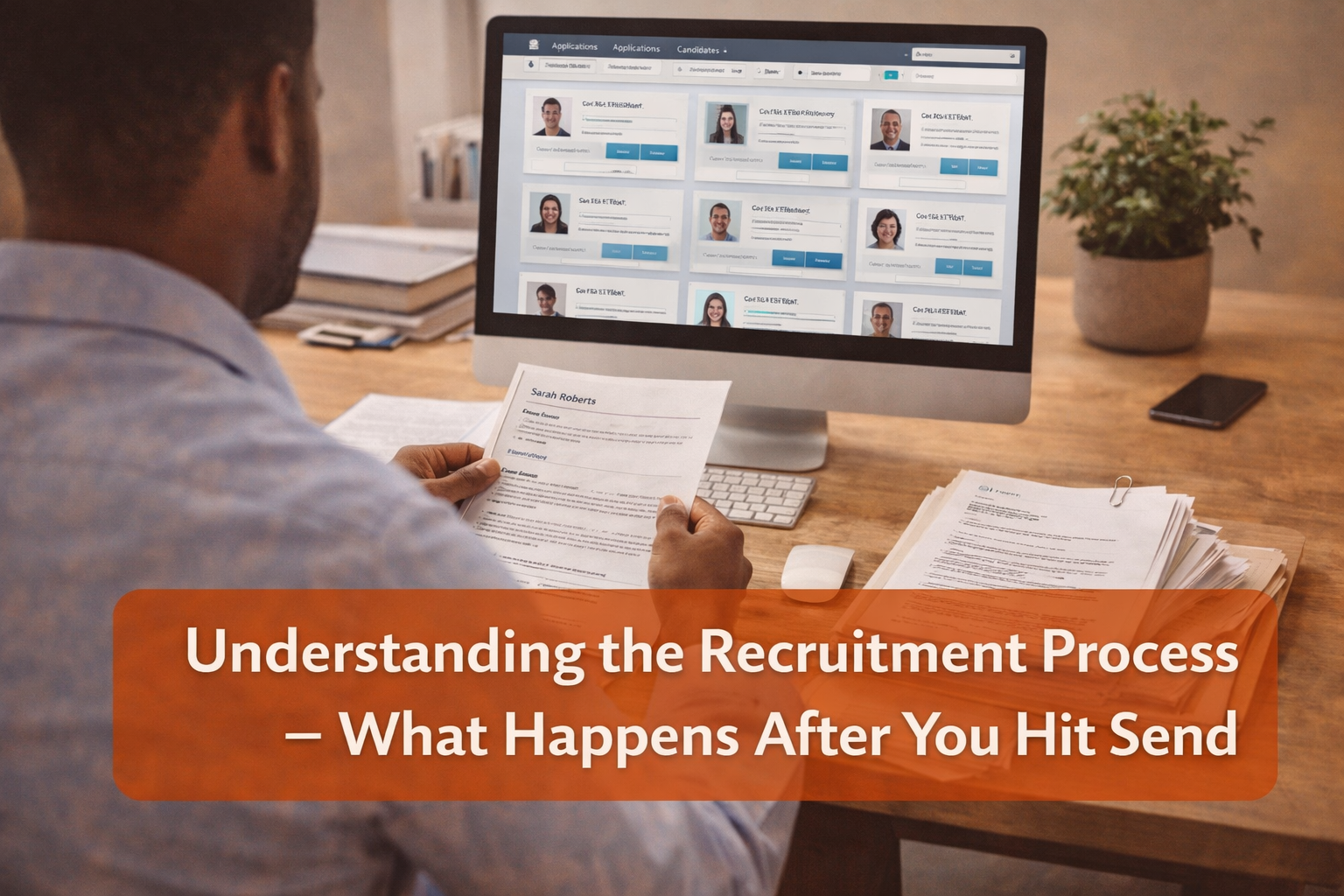
The Waiting Is the Hardest Part
You have put in the work. Your CV is polished. Your cover letter is strong. Your application is submitted. And now you wait.
For most job seekers, this is where the anxiety kicks in. Days pass. Then a week. Then two. You start wondering whether your application was even received. You wonder if you should follow up. You wonder if the silence means no. You refresh your email inbox more times than you would like to admit.
Here is the thing. Most of that anxiety comes from not knowing what is happening on the other side. When you understand the recruitment process, when you know what steps are involved, how long each one typically takes, and what the employer is actually doing while you wait, the whole experience becomes far less stressful.
This article pulls back the curtain on the hiring process from the employer’s side. By the end, you will know exactly what to expect after you submit an application, and you will be in a much better position to manage your time, your expectations, and your energy during the job search.
Every Company Does It Slightly Differently
Before we walk through the typical recruitment process, it is worth acknowledging that no two companies do it exactly the same way. A small business with ten employees might make a hiring decision in a week. A large corporate or government department might take three months. The process at a startup can be fast and informal. The process at a bank or a state-owned enterprise can be formal, multi-layered, and slow.
What we are going to cover here is the general shape of how most recruitment processes work. Understanding this framework will help you make sense of what is happening even when the specific details vary from one employer to the next.
Stage 1: The Job Is Posted
Everything starts when the employer decides they need to hire someone and posts a job advertisement. What you might not know is that a lot of work often happens before the post goes live.
The hiring manager, the person who leads the team or department with the vacancy, usually works with HR to define the role. They agree on the job title, the responsibilities, the required qualifications and experience, the salary range, and the key qualities they are looking for. This process can take days or even weeks, particularly in larger organisations.
The advertisement is then posted, whether on job portals, the company website, through a recruitment agency, or all of the above. A closing date is usually set, although not always.
What this means for you is that by the time you see a job posting, the employer already has a very clear picture of what they want. This is exactly why tailoring your application to the specific requirements of the advertisement, as we covered in Article 4, is so important.
Stage 2: Applications Are Collected
Once the job is live, applications start coming in. Depending on the role and the company’s profile, this could be anywhere from a handful to several hundred applications.
During this stage, the employer is mostly just collecting submissions. They are not typically reviewing applications in detail until the closing date has passed, or until enough applications have come in to make shortlisting worthwhile. This is why you might not hear anything for a week or two after applying. They have not forgotten about you. They are simply still gathering applications.
In larger companies, an Applicant Tracking System (ATS) is often doing the initial work here, scanning CVs for relevant keywords and filtering out applications that do not meet the basic requirements. As we discussed in Article 4, this is one of the reasons why using the right language and keywords in your CV matters so much.
Stage 3: Shortlisting
This is the first major decision point in the process. Someone, usually an HR officer or recruiter, goes through all the applications and identifies the candidates who best meet the requirements of the role. This shortlist might be twenty people for a popular position, or five or six for a more specialised one.
Shortlisting can be quick or slow depending on the volume of applications and the capacity of the HR team. In a busy organisation, it might take one to two weeks after the closing date. In a government department or large corporate, it can take longer.
At this stage, most applicants will not hear anything at all. Only the shortlisted candidates are typically contacted to move forward. This is frustrating, but it is the reality of how most organisations handle the volume of applications they receive. The majority of job seekers never hear back after applying, which is not a reflection of their worth as a candidate. It is simply a limitation of the system.
This is also why it is so important not to put all your hopes on a single application. Keep applying. Keep your pipeline active. Do not stop your job search just because you are waiting to hear back from one company.
Stage 4: The Initial Screening Call
If you make the shortlist, the first contact is often a brief telephone or video call with an HR officer or recruiter. This is sometimes called a screening interview or a pre-interview call, and its purpose is to confirm a few basic things before inviting you for a formal interview.
Typical questions at this stage include:
- Can you confirm your availability and notice period?
- What is your current salary, and what are your salary expectations?
- Can you tell me a little about your background and why you applied for this role?
- Are you comfortable with the location, working hours, or any other specific requirements of the role?
This call usually lasts between ten and twenty minutes. It is not a full interview, but it is still an important part of the process. You should treat it professionally. Be somewhere quiet when you take the call. Have your CV in front of you. Be ready to talk about your experience and your interest in the role clearly and confidently.
We will go into much more depth on interview preparation in Articles 9 and 10, but for now just know that this initial screening call is your first real opportunity to make a positive impression, and you should be ready for it at all times once you have started applying.
Stage 5: The Formal Interview
Candidates who pass the screening call are invited for a formal interview. This might be a single interview with the hiring manager, a panel interview with multiple people, or a series of interviews at different levels of the organisation. We will cover everything you need to know about preparing for and performing in interviews in Articles 9 and 10.
What is worth knowing here is how long the gap between the screening call and the formal interview typically is. In most cases, it is anywhere from a few days to two weeks. Scheduling an interview requires coordinating the availability of multiple people, which takes time. Be patient and stay engaged.
If a specific date and time is offered to you for an interview, confirm it promptly. If you need to reschedule, do so as soon as possible and with a genuine, brief reason. Cancelling an interview at the last minute, or simply not showing up, will almost certainly end your chances with that employer permanently.
Stage 6: Assessments and Background Checks
Many employers, particularly in financial services, government, education, and any role involving trust or security, include one or more assessments as part of their hiring process. These might include:
Psychometric assessments are personality or aptitude tests designed to give the employer insight into how you think, how you handle pressure, what your working style is, and how likely you are to fit with the team. There is generally no way to specifically prepare for these, and trying to give answers you think the employer wants to hear often backfires. The best approach is to answer honestly.
Skills or competency tests are practical assessments of a specific skill relevant to the role. A data entry test for an administrative position. A typing speed test. A written exercise for a communications role. A financial modelling task for a finance position. For these, practice is genuinely useful. Know what the role requires and make sure your relevant skills are sharp.
Background checks are very common in South Africa, particularly for roles involving financial responsibility, access to sensitive information, or work with vulnerable people. A background check might include a criminal record check, a credit check, a verification of your qualifications, and confirmation of your employment history.
It is important to be honest throughout your application about all of these things. Inconsistencies between what you claimed in your CV and what a background check reveals are one of the most common reasons offers are withdrawn at the last stage. Companies take this seriously.
Stage 7: The Job Offer
If everything goes well, the employer will make you a job offer. This might come through verbally first, usually in a phone call, followed by a formal written offer letter.
Read the offer letter carefully before accepting. Check the job title, the start date, the salary, the benefits, the working hours, and any conditions attached to the offer. We will cover everything you need to know about evaluating and negotiating a job offer in Article 13, but for now, just know that receiving an offer is not the same as accepting it. You are entitled to take a reasonable amount of time, usually 24 to 48 hours, to review the offer before responding.
Stage 8: The Waiting Period Before You Start
Once you have accepted an offer, there is often a waiting period before your start date. This might be a few days or several weeks, depending on whether you have a notice period at a current job, whether the employer needs to finalise onboarding paperwork, or whether they are waiting for a background check to be completed.
Use this time productively. Learn what you can about the company. Connect with your new manager or team on LinkedIn. Prepare yourself mentally and practically for the new role. Starting a new job with a clear head and a positive attitude makes a real difference.
How Long Does the Whole Process Take?
This is one of the most common questions job seekers have, and the honest answer is that it varies enormously.
For a small company making a straightforward hire, the whole process from job posting to offer can take as little as two to three weeks. For a large corporate, a government department, or a senior position, the same process can take two to four months or even longer.
As a rough general guide for South Africa:
- Small businesses and SMEs: two to six weeks
- Medium-sized companies: four to eight weeks
- Large corporates: six to twelve weeks
- Government and public sector: eight to sixteen weeks or more
These are approximations, not guarantees. The process can be delayed by public holidays, staff leave, budget approvals, internal restructuring, or simply a very high volume of applications. Some processes move faster than expected. Some drag on far longer than anyone intended.
The most important thing you can do while waiting is to keep applying for other roles. Never pause your job search while waiting to hear back from one employer. Keep your pipeline full. The moment you stop applying, you lose momentum, and momentum matters enormously in a job search.
What to Do While You Wait
Waiting is genuinely difficult, especially when you are under financial pressure or eager to make a change. Here are a few things that will help you use the waiting period constructively.
Keep applying. We have said this already, but it bears repeating. Your job search should be an ongoing process, not something you pause while you wait for one particular outcome.
Stay engaged with the companies you are interested in. Follow them on LinkedIn. Read their news. This keeps your knowledge fresh and your enthusiasm genuine, which will come through if and when you do get to interview stage.
Use the time to prepare. If you are waiting to hear back after an interview, use the time to prepare for a potential second interview. Research the company more deeply. Practise your answers to common questions. Think through the questions you want to ask them.
Look after yourself. Job searching is emotionally draining. Make sure you are maintaining some balance in your daily life. Exercise, socialise, pursue hobbies, and try not to let your job search consume every waking moment. A rested and balanced mind performs far better in interviews than an anxious and exhausted one.
Rejection Is Part of the Process
This deserves its own honest mention. Not every application will result in a callback. Not every interview will result in an offer. Rejection is a normal and expected part of the job search process, and it does not mean you are not good enough.
Sometimes you were a strong candidate but someone else was a slightly better fit. Sometimes the role was filled internally after being advertised. Sometimes the company’s needs changed during the process. These things happen all the time and they have nothing to do with your value as a person or a professional.
What matters is how you respond to rejection. Stay positive, stay active, and keep going. Every application teaches you something. Every interview makes you better. The job search is a process, and if you keep showing up with energy and preparation, the right opportunity will come.
Before You Move On, Complete These Steps
Waiting is part of the process, but it should never mean doing nothing. Use this time to stay active, prepared, and in control of your job search.
- Review the Recruitment Process
Make sure you understand the typical stages:- Application → Shortlisting → Screening Call → Interview → Offer
This helps you stay calm and realistic while waiting.
- Check Your Application Tracker
Update your tracker with:- Any new applications
- Dates and deadlines
- Apply for Additional Jobs
Submit at least 2 to 3 new applications so you are not relying on just one opportunity. - Prepare for a Screening Call
Be ready at any time by:- Reviewing your CV
- Practising a short introduction about yourself
- Knowing your salary expectations and availability
- Keep Your Phone and Email Ready
Make sure:- Your phone is reachable during the day
- You check your email regularly
- Set Follow-Up Reminders
For each application:- Set a reminder to follow up after 1 to 2 weeks (if appropriate)
- Research Your Target Companies
Spend time:- Learning more about companies you applied to
- Following them on LinkedIn
- Start Preparing for Interviews
Begin light preparation by:- Thinking about common interview questions
- Reflecting on your past experience and examples
- Manage Your Mindset
Remind yourself:- Not hearing back immediately is normal
- Rejection is part of the process
- Consistency is what leads to success
Only move on once you are actively applying and staying prepared while you wait.



March 26, 2026
[…] Next up: Article 8, Understanding the Recruitment Process, where we pull back the curtain on what ac… […]