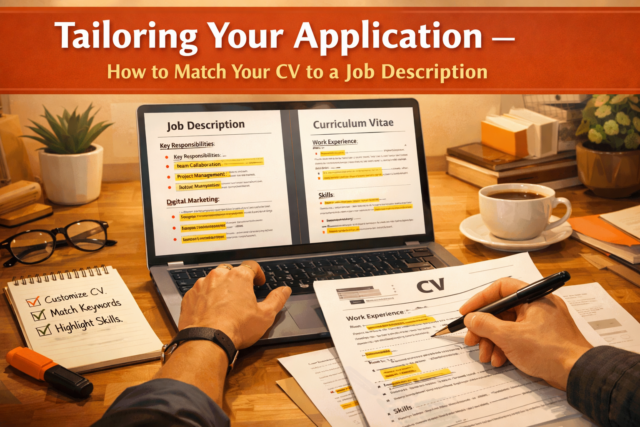
One CV Does Not Fit All
Here is something that most job seekers do not realise, and it is costing them interviews every single day.
When you send the exact same CV to fifty different employers, you are essentially telling each one of them, “I did not think specifically about you or your job. I just sent you what I send everyone.” Employers can feel that. Recruiters especially, because they see hundreds of applications and they know a generic CV when they see one.
Now here is the flip side. When you take your CV and adjust it, even slightly, to speak directly to what a specific employer is looking for, your application immediately feels more relevant, more considered, and more impressive. You are not just another applicant. You are someone who took the time to understand the role and explain why you are the right fit for it.
This is called tailoring your application, and it is one of the most powerful things you can do to improve your chances of getting an interview. The best part is that once you understand how to do it, it does not take very long at all.
Why Tailoring Works
To understand why this matters so much, it helps to think about what happens on the employer’s side of the process.
When a company decides to hire someone, they sit down and think carefully about what they need. They write a job description that outlines the responsibilities of the role and the requirements they are looking for in a candidate. That document is not just a formality. It is a detailed wish list.
When applications start coming in, the person doing the screening, whether that is an HR manager, a recruiter, or the hiring manager themselves, is essentially trying to match what they see in each CV against that wish list. They are asking, “Does this person have what we asked for?”
If your CV uses a completely different language from the job description, talks about experiences that are not relevant to the role, and buries the most important information somewhere on page two, the screener has to work hard to find the match. And they often will not bother.
But if your CV reflects the same language and priorities as the job description, highlights the exact skills and experience they asked for, and makes the match obvious from the very first paragraph, the screener’s job becomes easy. And easy applications get shortlisted.
There is also a more technical reason why tailoring matters. Many larger companies in South Africa now use Applicant Tracking Systems, which are software programmes that scan CVs automatically before a human ever reads them. These systems are programmed to look for specific keywords from the job description. If your CV does not contain those keywords, it may be filtered out before it reaches a person at all. Tailoring your CV to include the right keywords helps you get past this first digital gate.
Step 1: Read the Job Description Carefully. Really Carefully.
Before you change a single word on your CV, you need to understand the job you are applying for properly. This means reading the job description slowly and thoroughly, not just skimming it for the job title and the salary.
As you read, pay attention to the following:
The required qualifications. What level of education or training is the employer asking for? Is it a minimum requirement or a preference? If they say “degree preferred” rather than “degree required,” that is an important distinction.
The required experience. How many years of experience are they asking for, and in what area? Are there specific industries or types of roles they mention?
The key responsibilities. What will this person actually be doing day to day? This tells you a lot about what skills and experience are most important to them.
The specific skills mentioned. Are there particular software programmes, technical skills, languages, or professional abilities listed? These are almost always important.
The language and tone of the posting. Is it formal and corporate, or is it friendly and casual? This tells you something about the company culture and can inform the tone of your cover letter later.
Any repeated words or phrases. If the same word appears two or three times in a job description, it is almost certainly important to the employer. Take note of it.
Once you have read through it carefully, highlight or write down the five to eight things that seem most important to the employer. These are your targets for the tailoring process.
Step 2: Compare What They Want to What You Have
Now take your list of what the employer wants and compare it honestly to your own skills, experience, and qualifications.
For most job seekers, this comparison will show three things:
Things you match well. These are the skills or experiences you have that directly align with what the employer is asking for. These need to be clearly visible in your CV, ideally near the top.
Things you partially match. Maybe you have some relevant experience but not in exactly the same context. Maybe you have a related skill but not the specific one they mentioned. These are still worth including, but you may need to frame them carefully to show the connection.
Things you do not match. These are requirements you genuinely do not have. Be honest with yourself here. If a job requires five years of financial management experience and you have none, it is probably not the right application to spend time on. However, if you are missing one or two minor requirements but match everything else strongly, it is still worth applying. Job descriptions are often wish lists, and employers know they rarely find someone who ticks every single box.
Step 3: Adjust Your Professional Summary
Your professional summary, that short paragraph at the top of your CV, is the first thing the reader sees and the easiest place to start tailoring.
Go back to your list of what the employer wants most. Now rewrite your professional summary so that it speaks directly to those priorities. You do not need to completely reinvent it every time. Often, small adjustments make a big difference.
Here is an example. Imagine you have this generic professional summary:
“Experienced administrator with strong organisational skills and a background in office management. I am a reliable team player with good communication skills and a willingness to learn.”
Now imagine the job description is for an administrative coordinator at a healthcare company. It emphasises accuracy, confidentiality, experience with medical records, and proficiency in Microsoft Office.
A tailored version of that summary might read:
“Detail-oriented administrative professional with six years of experience in healthcare administration, including management of patient records and confidential documentation. Proficient in Microsoft Office Suite with a strong track record of accuracy and compliance in high-pressure environments. Looking to bring well-developed organisational and communication skills to a coordinator role within a healthcare setting.”
Same person. Same experience. But the tailored version speaks directly to what this employer is looking for. It is far more likely to get read.
Step 4: Reorder and Adjust Your Work Experience
The order in which you present information on your CV matters. Employers read from the top down, and their attention tends to fade as they go further down the page. This means the most relevant information should come first wherever possible.
Within each job description on your CV, look at your bullet points and ask yourself: which of these responsibilities or achievements are most relevant to the job I am applying for? Move those to the top of the list. Deprioritise or remove bullet points that are less relevant.
For example, if you are applying for a sales role and your most recent job involved both sales and administrative work, lead with your sales achievements and put the admin duties at the bottom. The reader will naturally pay more attention to the first two or three bullet points under each role.
You can also consider adding or expanding on certain details depending on what is relevant. If the job description places a lot of emphasis on client relationship management, and you have experience in this area that you previously described in very brief terms, now is the time to expand on it and give it the space it deserves.
Step 5: Match the Keywords
This is where you get a little bit strategic, without being dishonest.
Go back to the important words and phrases you identified in the job description. Now look at your CV and check whether those same words appear. If they do not, see whether you can naturally incorporate them.
For example, if the job description says “stakeholder engagement” and your CV says “working with clients,” consider updating your CV to use the term “stakeholder engagement” if that is genuinely what you did. The experience is the same, but using the employer’s language makes the match much more obvious, both to a human reader and to any automated screening system.
Do not stuff your CV with keywords in a way that feels unnatural or dishonest. The goal is to make sure that the genuine experience and skills you have are described in language that clearly connects with what the employer is looking for. That is not manipulation. That is good communication.
Step 6: Check Your Skills Section
Review your skills section with the job description in mind. Are there relevant skills you have that you left out of your current CV? Add them. Are there skills you listed that are completely irrelevant to this particular role and are taking up valuable space? Consider removing them or moving them lower.
If the job description specifically mentions a software programme, a tool, a methodology, or a language that you have experience with and it is not already in your skills section, add it now.
How Much Should You Change Your CV?
This is a reasonable question, and the honest answer is: it depends on how different each job is from the last one you applied for.
If you are applying for similar roles within the same industry, your changes might be quite minor. A few tweaks to the professional summary, a reordering of some bullet points, and a keyword check might be all you need.
If you are applying for a role in a different industry or at a significantly different level, you may need to make more substantial changes, essentially building a different version of your CV that emphasises a different set of experiences.
A useful approach is to keep a master CV that contains everything, every job, every skill, every achievement, and then create trimmed, tailored versions from that master document for each application. This way you are not starting from scratch each time, just selecting and adjusting what is most relevant.
A Word on Honesty, Again
Tailoring your CV is about presentation and emphasis, not fabrication. You are highlighting what is most relevant, not inventing things that are not true.
Every claim you make in your CV needs to be something you can back up in an interview. If you describe yourself as proficient in a software programme, be prepared to talk about how you have used it. If you say you managed a team, be ready to describe that experience in detail. Interviewers are good at spotting claims that candidates cannot actually support.
The goal of tailoring is to make sure the real you, with your genuine skills and experience, comes across as clearly and compellingly as possible to the right employer. When you do it well, it does not feel like manipulation at all. It just feels like good communication.
The Payoff Is Worth the Effort
Tailoring a CV takes a bit more time than blasting out the same document everywhere. But the return on that time investment is significant. A well-tailored application is more likely to get past automated screening, more likely to get read properly, and more likely to result in an interview.
Think of it this way. Would you rather send out fifty generic applications and hear nothing back, or send out fifteen carefully tailored ones and get five interviews? The answer seems obvious when you put it that way.
Quality over quantity. Every time.
Before You Move On, Complete These Steps
You now have a solid CV. The next step is learning how to adapt it for each job. Do not skip this, this is where most people lose opportunities.
- Select a Real Job to Work With
Find 1 job listing that you would genuinely apply for and use it as your example for this exercise. - Break Down the Job Description
Carefully read the job and write down:- 5 to 8 key requirements
- Important skills or tools mentioned
- Repeated words or phrases
- Match the Job to Your Experience
Compare the job requirements with your CV and identify:- What you match strongly
- What you partially match
- What you do not match
- Rewrite Your Professional Summary
Adjust your summary so that it clearly reflects:- The type of role you are applying for
- The most relevant skills from the job description
- Reorder Your Work Experience
In your most recent job:- Move the most relevant bullet points to the top
- Reduce or remove less relevant tasks
- Update Your Keywords
Look at your CV and:- Add important words from the job description where appropriate
- Replace generic wording with more specific, relevant terms
- Adjust Your Skills Section
Make sure:- Your most relevant skills are clearly visible
- Any important skills from the job description are included (if you have them)
- Create Your First Tailored CV
Save this version separately using a clear name:- YourName_JobTitle_CV.pdf
- Build Your Master CV System
Create:- One master CV with everything included
- A habit of creating tailored versions for each application
Only move on once you have successfully tailored your CV for at least one real job.


March 26, 2026
[…] Next up: Article 4, Tailoring Your Application, where we look at why one CV does not fit all, and ex… […]