Stop Scrolling and Start Searching Smarter
If you have ever spent hours scrolling through job listings online, feeling like nothing quite fits, or wondering why the same companies seem to pop up over and over again, you are not alone. Most job seekers in South Africa use just one or two platforms and hope for the best. The problem with that approach is that you end up seeing only a small slice of what is actually available.
The South African job market is bigger and more varied than most people realise. There are jobs being filled through company websites, through recruitment agencies, through WhatsApp groups, through community notice boards, and through personal connections. If you are only looking in one place, you are missing a lot.
This article is going to show you exactly where to look, how to look smarter, and how to get a feel for what employers in South Africa are actually looking for right now. By the end, you will have a much clearer picture of the job landscape, and a practical plan for where to focus your energy.
First, Understand How the South African Job Market Works
Before we get into the where, it helps to understand a little about how hiring works in South Africa. This will save you a lot of frustration.
South Africa has a high unemployment rate, which means competition for many jobs is fierce. When a company posts a popular position, they can receive hundreds of applications. This is actually useful information for you, because it means you need to be strategic. Sending out dozens of generic applications is unlikely to get you far. Sending out fewer, well-targeted, well-prepared applications will almost always serve you better.
It is also worth knowing that not all jobs are advertised publicly. Many positions, particularly at smaller companies, are filled through word of mouth, referrals, or recruitment agencies before they ever appear on a job portal. This is sometimes called the “hidden job market,” and we will talk about how to tap into it later in this article.
South Africa also has specific employment legislation that affects hiring, including the Employment Equity Act, which encourages companies to hire from previously disadvantaged groups. This means that for certain positions, candidates from designated groups may be given preference. Being aware of this helps you understand why you may sometimes not be shortlisted even when you feel you are qualified, and it also means that if you fall within a designated group, this can work in your favour. Many job advertisements will state their employment equity requirements clearly.
The Main Online Job Portals in South Africa
Online job portals are the most obvious starting point, and they are genuinely useful. Here are the main ones worth knowing about.
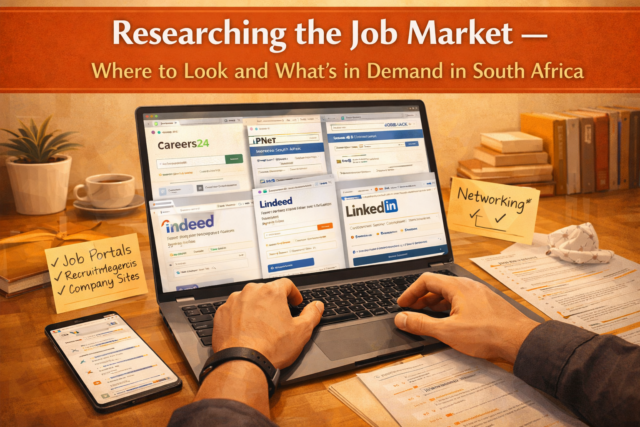
Careers24 (www.careers24.com) is one of the largest and most well-known job portals in South Africa. It covers a wide range of industries and salary levels, from entry-level positions all the way to senior management roles. You can create a profile, upload your CV, and set up alerts so that new matching jobs land in your inbox automatically.
PNet (www.pnet.co.za) is another major platform with a large database of listings. It is particularly strong in professional and white-collar roles, but covers a broad range of sectors. Like Careers24, you can build a profile and have employers find you.
Indeed South Africa (za.indeed.com) pulls job listings from across the internet, including company websites and other portals, so it often surfaces jobs that you would not find on Careers24 or PNet alone. It is a great aggregator to use in addition to the dedicated local platforms.
LinkedIn (www.linkedin.com) deserves its own special mention. LinkedIn is not just a job board, it is a professional networking platform, and in South Africa it is increasingly being used by recruiters to find candidates directly. Even if you are just starting out, having a LinkedIn profile is worth the effort. We will cover this in much more detail in Article 7, but for now, know that it belongs in your job search toolkit.
JOBJACK (www.jobjack.co.za) is a South African platform specifically focused on entry-level and semi-skilled positions. If you are just starting your career or do not yet have formal qualifications, this is a very useful site to know about.
Government Jobs (www.dpsa.gov.za) is the official government portal for public sector vacancies in South Africa. Government jobs are advertised through the Department of Public Service and Administration, and the process of applying for them is slightly different from private sector jobs. If you are interested in working for a government department, municipality, or state-owned entity, this is where to look.
Gumtree (www.gumtree.co.za) is better known as a classifieds site, but it has a jobs section that is particularly strong for domestic work, trades, hospitality, and informal sector roles. It is worth checking, especially for more hands-on or practical positions.
Go Directly to Company Websites
This is something a lot of job seekers overlook, and it is a real missed opportunity. Many companies post their vacancies directly on their own websites, often in a section called “Careers” or “Work With Us” or “Join Our Team.” These jobs are sometimes not listed anywhere else.
Make a list of companies you would genuinely like to work for. Then go to each of their websites and find the careers section. Check it regularly, every week or two, because listings come and go quickly.
This approach has another hidden advantage. When you apply for a job directly through a company’s own website, you are showing that you went looking for them specifically. That is a small but meaningful signal of genuine interest, and some recruiters do notice it.
Recruitment Agencies Are Your Friends
Recruitment agencies act as the middlemen between job seekers and employers. Companies use them to help find candidates, especially for more specialised or senior roles. As a job seeker, registering with a recruitment agency is free, and it can open doors that you would not find through a job portal.
When you register with an agency, a consultant will typically have a conversation with you about your skills, experience, and what you are looking for. They then keep your details on file and contact you when a suitable role comes up. They also often have access to positions that are never publicly advertised.
Some well-known recruitment agencies operating in South Africa include:
Adcorp, Kelly Group, Manpower, Communicate Recruitment, Network Recruitment, and Unique Personnel. There are also many smaller, more specialised agencies that focus on specific industries like finance, engineering, IT, healthcare, and hospitality. A quick Google search for recruitment agencies in your field or your area will bring up plenty of options.
When dealing with a recruitment agency, always remember that their primary client is the employer, not you. They are trying to fill a position, and they will put you forward if they genuinely believe you are a good match. Be honest with them about your skills and experience. Trying to oversell yourself will only lead to problems later.
Do Not Underestimate the Power of Your Network
In South Africa, as in many places around the world, a huge number of jobs are filled through personal connections. Someone mentions to a colleague that their company is hiring. A manager reaches out to someone they know. A friend passes on a CV. This kind of informal hiring happens all the time, and it is not unfair, it is just how people work.
This means that your network, the people you know, is one of your most valuable job search tools. And a network is not just about knowing powerful or well-connected people. It includes:
- Former colleagues and managers
- Friends and family members who are currently employed
- People you studied or trained with
- People you have met through community activities, church, sport, or volunteering
- Neighbours and acquaintances who work in industries you are interested in
You do not need to make it awkward. Simply let people know that you are looking for work and what kind of role you are interested in. Most people are happy to help if they can, whether that means mentioning your name to their HR department, sharing a job listing they saw, or giving you a reference.
Do not be too proud to ask. Looking for work is normal. Asking for help is smart.
Social Media and WhatsApp Groups
Beyond LinkedIn, there are several other social media channels worth paying attention to when job hunting in South Africa.
Facebook has a surprising number of job-related groups. Search for terms like “Jobs in [your city]” or “South Africa jobs” or “[industry] jobs South Africa” and you will find active groups where employers and recruiters post vacancies regularly. These groups are particularly active for hospitality, domestic work, security, retail, and general labour positions.
WhatsApp groups are widely used in South Africa for sharing job opportunities, particularly in communities where smartphone access is easier than desktop internet access. If you are part of community groups, neighbourhood groups, or industry-related groups on WhatsApp, pay attention. Jobs are often shared informally in these spaces.
Twitter / X is used less for job postings directly, but some recruiters and companies do announce vacancies there. More usefully, following companies and industry figures on Twitter can keep you informed about what is happening in your field, which is useful for interview preparation.
What Industries Are Currently in Demand?
Understanding where the demand for workers is strongest in South Africa can help you decide where to focus your energy, whether you are just starting out or considering a career change.
Information Technology (IT) and Software Development remain in very high demand. South Africa has a significant shortage of software developers, data analysts, cybersecurity specialists, and IT support professionals. If you have any inclination towards tech, investing in training in this area is one of the best career moves you can make.
Healthcare and Social Services are consistently understaffed. Nurses, carers, community health workers, pharmacists, and healthcare administrators are needed across both the public and private sectors.
Renewable Energy and Green Sectors are growing rapidly in South Africa, particularly given the energy challenges the country has faced. Solar installation, electrical engineering, and project management roles in the energy sector are increasingly in demand.
Construction and Infrastructure remain strong, with ongoing government and private sector investment in roads, housing, and utilities.
Financial Services including accounting, bookkeeping, auditing, and financial advisory roles are consistently in demand, particularly for candidates with recognised qualifications.
Hospitality and Tourism, while it took a knock during the COVID-19 pandemic, has bounced back strongly. South Africa’s tourism sector is a significant employer, and there are opportunities across accommodation, food and beverage, travel, and game lodges.
Logistics and Supply Chain have grown substantially, driven partly by the growth of e-commerce. Drivers with valid professional driving permits (PrDPs), warehouse workers, and logistics coordinators are regularly sought after.
Education remains a sector where qualified teachers, particularly in maths, science, and technology subjects, are in short supply.
Retail and Customer Service are sectors that absorb a large number of workers at various levels. While individual salaries can be modest, the volume of available positions is high, making this a realistic starting point for many job seekers.
How to Stay Up to Date With What Employers Want
The job market changes over time. Skills that were not valued five years ago are now in high demand. The best way to stay current is to make a habit of reading job listings regularly, even when you are not actively looking.
Pay attention to the requirements that appear over and over again in your target industry. If you notice that almost every job posting in your field asks for a skill you do not have, that is a signal worth acting on. Maybe it is time to do an online course.
Some good free and low-cost learning platforms available to South Africans include:
Coursera, edX, and LinkedIn Learning offer courses on almost any professional skill you can think of. Many have free options.
Umuzi, WeThinkCode, and HyperionDev are South Africa-based organisations that offer training specifically designed to help people enter the tech industry, sometimes with very accessible entry requirements.
SETA-accredited training through Sector Education and Training Authorities (SETAs) is available in many industries and is often government-funded, making it free or heavily subsidised for qualifying candidates.
Build Your Target List
By the end of your research phase, you should have a focused target list that includes:
- Two or three job portals you will check regularly
- A list of companies you want to work for, with their careers pages bookmarked
- One or two recruitment agencies you have registered with
- A few Facebook groups or online communities where jobs in your field are shared
- A clear sense of which industries are hiring and what skills they are looking for
This is not about applying for everything you find. It is about knowing your territory before you start your search. The more informed you are about the job market, the smarter your applications will be, and the more confident you will feel throughout the whole process.
You Know More Than You Did Yesterday
Researching the job market can feel a bit like studying for an exam. It takes a bit of effort upfront, but once you have done it, everything clicks into place more easily. You will start recognising company names, understanding industry trends, and spotting the kinds of roles that really suit you.
The job seekers who do this groundwork are the ones who send better applications, walk into interviews more confidently, and ultimately get hired faster. It is not magic. It is just preparation.
Before You Move On, Complete These Steps
You now understand where jobs are actually found. Before moving on, you need to set up your own job search system. This will save you time and stop you from feeling overwhelmed.
- Select Your Main Job Platforms
Choose 2 to 3 job platforms you will use consistently (for example Careers24, PNet, Indeed, or JOBJACK). Do not try to use everything. - Create or Update Your Profiles
On your chosen platforms:- Create your profile
- Upload your current CV (even if it is not perfect yet)
- Set up job alerts where possible
- Build Your Company Target List
Write down 5 to 10 companies you would like to work for. Then:- Visit each company’s website
- Find and bookmark their “Careers” page
- Register With Recruitment Agencies
Choose at least 1 or 2 recruitment agencies relevant to your field and:- Register your details
- Upload your CV
- Activate Your Network
Contact at least 3 people (friends, family, former colleagues) and let them know:- You are looking for work
- What type of job you are looking for
- Join Job Communities
Find and join:- At least 2 Facebook job groups
- Relevant WhatsApp or community groups (if available)
- Identify In-Demand Skills in Your Field
Look at at least 5 job listings in your chosen field and write down:- Skills that appear repeatedly
- Requirements you currently do not meet
- Create Your Job Search Plan
Write down your weekly routine:- Which platforms you will check
- How often you will check them (daily or weekly)
- Which companies you will monitor
Only move on once your job search system is set up.




March 26, 2026
[…] Next up: Article 2, Researching the Job Market, where we look at where to find job opportunities in … […]
March 26, 2026
[…] Next up: Article 2, Researching the Job Market, where we look at where to find job opportunities in … […]