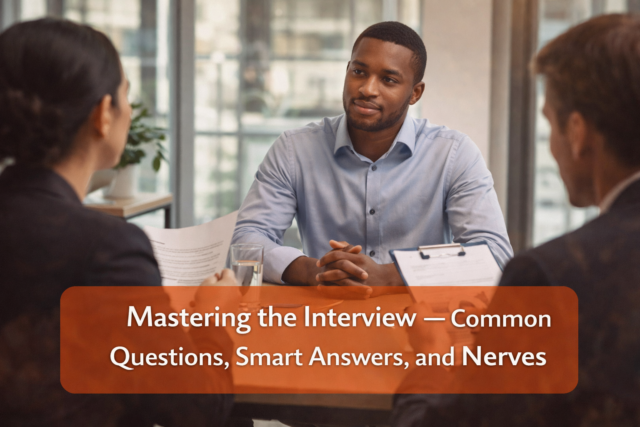
You Are Ready. Now Let’s Talk About the Room.
Article 9 was all about preparation. The research, the logistics, the planning. If you have done all of that, you are already ahead of most of the people you are competing with.
But now comes the part that makes most people nervous. The actual interview. Sitting across from one or more strangers, knowing they are evaluating you, trying to say the right things, trying not to say the wrong things, trying to remember everything you prepared while also listening carefully and appearing calm and confident.
It is a lot. And it is completely normal to feel nervous about it.
Here is what most people do not realise though. Nerves are not the enemy. They are a sign that you care, and caring is a good thing. The goal is not to eliminate your nerves but to manage them well enough that they do not get in your way. And the best tool for managing nerves is, once again, preparation. Which you have already done.
This article is about what happens inside the interview itself. How to make a strong first impression, how to answer questions well using a proven technique, how to handle the difficult or unexpected questions, how to read the room, and how to close the interview in a way that leaves a lasting positive impression.
The First Two Minutes Matter More Than You Think
Research consistently shows that interviewers form a strong initial impression of a candidate within the first few minutes of meeting them. This does not mean the rest of the interview does not matter, it absolutely does. But your opening impression sets the tone for everything that follows.
Here is how to make those first two minutes count.
Be warm and professional from the moment you arrive. Greet the receptionist pleasantly. If you are kept waiting, be patient and friendly. When your interviewer comes to collect you, stand up, make eye contact, smile, and shake hands firmly but not crushingly. In some South African cultural contexts, a two-handed handshake is a sign of respect and warmth. Use your judgement based on the environment and the person in front of you.
Walk in with intention. Your posture and body language communicate confidence before you say a word. Stand tall, walk with purpose, and avoid the instinct to hunch or make yourself small when you feel nervous.
Start the conversation before the interview officially starts. A brief, genuine exchange of pleasantries while you are walking to the interview room or settling in helps break the ice and shows that you are a relaxed, sociable person. You do not need to be overly chatty. Just be warm and present.
Settle yourself before answering the first question. Once you are seated and the interview begins, take a breath before you start speaking. There is no requirement to answer instantly. A moment of calm before your first answer signals composure and thoughtfulness.
How to Answer Questions Well: The STAR Method
One of the most effective techniques for answering interview questions is the STAR method. It is particularly useful for behavioural questions, the kind that begin with phrases like “Tell me about a time when…” or “Give me an example of…” or “Describe a situation where…”
STAR stands for:
S — Situation. Briefly describe the context. Where were you working? What was the background to the situation?
T — Task. What was your specific role or responsibility in that situation? What were you trying to achieve or what problem were you trying to solve?
A — Action. This is the most important part. What did you specifically do? Walk the interviewer through the steps you took, the decisions you made, and how you approached the challenge. Use “I” rather than “we” here, because the interviewer wants to know what you did, not what the team did.
R — Result. What was the outcome? What happened as a result of your actions? Where possible, quantify the result. Did you save time? Improve a score? Resolve a complaint? Increase sales? Numbers and specifics are far more convincing than vague statements.
Here is an example of the STAR method in action:
Question: “Tell me about a time when you had to deal with a difficult customer.”
Weak answer: “I have dealt with lots of difficult customers in my career. I always stay calm and try to resolve the issue as quickly as possible.”
This answer is vague and tells the interviewer nothing specific.
STAR answer:
“In my previous role at a retail store in Pretoria, we had a situation where a customer came in extremely upset about a product she had bought that had stopped working after two weeks. She was demanding a full refund and threatening to post on social media about the experience. [Situation]
My task was to resolve her complaint quickly and professionally while also following the store’s returns policy, which technically did not cover the full refund she was asking for. [Task]
I listened to her fully without interrupting, acknowledged her frustration, and apologised sincerely for the inconvenience. I then explained the returns policy clearly and calmly, and I used my discretion as a senior sales assistant to offer her a replacement product plus a store voucher as a gesture of goodwill. [Action]
She left satisfied and actually came back the following week to thank me in person. The store manager used the situation as a case study in our next team meeting as an example of good customer recovery. [Result]”
See how much more compelling and credible the second answer is? It paints a picture. It shows real skill in action. And it ends with a result that confirms the approach worked.
Practice telling two or three strong stories using the STAR method before your interview. Draw from real experiences in previous jobs, volunteer work, academic projects, or any other relevant context. Having these stories ready in your mind means you can adapt them to answer a wide range of questions without having to think on your feet.
Common Interview Questions and How to Handle Them
We touched on some of these in Article 9, but let us go deeper here, because how you answer these questions in the room is different from just knowing what to say.
“Tell me about yourself.”
Keep it to two to three minutes. Start with a brief summary of your professional background, move to your key strengths, and end with why you are excited about this specific opportunity. Do not start from your childhood. Do not list everything on your CV. Think of it as a highlight reel, not a full documentary.
Practice this answer out loud until it flows naturally. It should not sound rehearsed. It should sound like you are telling your story comfortably because you know it well.
“Why do you want this job?”
Connect your genuine motivations to something specific about the role or the company. Do not say “because I need a job” or “because the salary is good.” Talk about what genuinely interests you about the work, the company, or the opportunity to grow.
“What is your greatest strength?”
Be specific. Pick one or two genuine strengths that are directly relevant to the role. Back them up with a brief example. Avoid generic answers like “I am a hard worker” because everyone says that and it means nothing without evidence.
“What is your greatest weakness?”
Choose a genuine weakness that is not a core requirement of the role. Show that you are self-aware and actively working to improve. Avoid the classic trap of disguising a strength as a weakness, “I just work too hard sometimes” or “I am a bit of a perfectionist.” Interviewers have heard these a thousand times and they are not impressed by them.
“Why did you leave your last job?”
Stay positive. Focus on what you are moving towards, not what you are escaping from. Never criticise your former employer, manager, or colleagues. Even if your reasons for leaving were entirely justified, speaking negatively about a previous employer raises concerns for interviewers about how you might speak about them one day.
“What are your salary expectations?”
Do your research before the interview so you know the market rate for the role. Give a range rather than a single number, and make it a range you are genuinely comfortable with at both ends. We will go into salary negotiation in detail in Article 13, but for now, knowing your number and being able to state it calmly and confidently is the goal.
“Where do you see yourself in five years?”
Show ambition without being unrealistic. Align your answer with the growth opportunities the company is likely to offer. You do not need a precise plan. You just need to show that you are thinking forward and that this role is a meaningful part of that journey.
Handling Difficult or Unexpected Questions
Even the best-prepared candidates sometimes face a question they did not anticipate. Here is how to handle it well.
It is fine to take a moment. If a question catches you off guard, it is completely acceptable to say, “That is a great question. Let me think about that for a moment.” A brief pause to think is a sign of thoughtfulness, not weakness. Rushing to fill the silence with the first thing that comes to mind often leads to less coherent answers.
Ask for clarification if needed. If you are not sure exactly what the interviewer is asking, it is better to clarify than to answer the wrong question. “Just to make sure I understand what you are looking for, are you asking about X or Y?” shows good communication skills.
Be honest if you do not know something. If you are asked a technical question or a knowledge question that you genuinely cannot answer, do not bluff. Say honestly that you are not certain, explain what your current understanding is, and indicate that you would be keen to find out more. Honesty and intellectual curiosity are far better than a confident wrong answer.
Stay calm if the interviewer pushes back. Some interviewers, particularly in more senior roles, will deliberately challenge your answers to see how you respond under pressure. They might say “Are you sure about that?” or “I am not sure I agree with that approach.” Do not crumble. Do not immediately agree with them just to avoid conflict. Stay calm, consider what they have said, and either defend your position with reasoning or acknowledge their point if it has genuine merit.
Body Language and How You Come Across
What you say in an interview is important. But how you carry yourself while you are saying it matters just as much. Here are the key things to be aware of.
Make eye contact. Look at the person who is speaking to you and the person you are speaking to. If there are multiple interviewers, distribute your eye contact naturally. Avoid staring at the table or looking away when you are thinking. It can come across as evasive.
Avoid closed body language. Folded arms, hunched shoulders, and turning your body away from the interviewers all signal defensiveness or discomfort. Sit up straight, keep your hands relaxed in front of you, and face the interviewers fully.
Nod and respond to show you are listening. When the interviewer is speaking, show that you are engaged. Nod occasionally, maintain eye contact, and give brief verbal acknowledgements like “yes” or “I see” where appropriate. This shows respect and active listening.
Control nervous habits. Many people have nervous habits they are not even aware of, tapping fingers, jiggling a leg, clicking a pen, touching their face repeatedly. These signals distract the interviewer and undermine your air of confidence. Try to be aware of yours and consciously keep them in check.
Smile genuinely. Not a permanent fixed grin, but natural, warm smiles at appropriate moments. Warmth and likability are real factors in hiring decisions. People hire people they want to work with.
Closing the Interview Strongly
The end of the interview is just as important as the beginning. How you close leaves the final impression, and that is the one that sticks.
Ask your prepared questions. As we covered in Article 9, having genuine, thoughtful questions ready shows curiosity and engagement. This is the moment to ask them.
Express your enthusiasm clearly. Before you leave, tell the interviewers directly that you are genuinely excited about the role and the company. Something like: “I just want to say that the more I have heard about the team and the work you are doing, the more excited I am about this opportunity. I would love the chance to be part of it.”
This might feel a little forward, but it is not. Most interviewers appreciate hearing genuine enthusiasm. It removes any ambiguity about your interest and it leaves them with a positive feeling about you.
Ask about the next steps. Before you leave, ask what the process looks like from here and when you might expect to hear back. This gives you a timeline to work with and shows that you are organised and eager to move forward.
Thank them sincerely. Thank each interviewer by name for their time. A firm handshake, a genuine smile, and a warm but brief farewell.
After You Leave
The moment you walk out of the interview, find a quiet moment to write down your impressions while they are fresh. What questions were asked? How did you answer them? What went well? What would you do differently? This reflection is valuable preparation for follow-up conversations or second interviews.
Send a brief thank-you email within 24 hours. It does not need to be long. A short, sincere note thanking the interviewers for their time, reiterating your interest in the role, and mentioning one specific thing from the conversation that reinforced your enthusiasm is all it needs to be. Very few candidates do this, which means it stands out when you do.
The Interview Is a Conversation, Not an Interrogation
The single most helpful shift in mindset you can make about interviews is this. An interview is not something that is done to you. It is a conversation between two parties who are both trying to figure out if there is a good fit.
The employer is not your judge. They are a potential partner. They want to find the right person just as much as you want to find the right opportunity. When you walk in with that mindset, relaxed, curious, and genuinely engaged, you will perform far better than if you walk in feeling like you are on trial.
You have prepared. You know your story. You are ready to show them what you can do. Now go in there and have a great conversation.
Before You Move On, Complete These Steps
This is where preparation turns into performance. Before moving on, make sure you are ready to handle the interview itself with confidence.
- Prepare Your Opening Introduction
Practise your answer to:- “Tell me about yourself” (2 to 3 minutes)
- Focus on your experience, strengths, and why you are there
- Prepare 2 to 3 STAR Stories
Think of real examples where you:- Solved a problem
- Handled a challenge
- Worked with people or customers
Structure them using Situation, Task, Action, Result.
- Practise Answering Key Questions Out Loud
Say your answers out loud to improve flow and confidence. - Prepare for Difficult Questions
Be ready to handle:- Weaknesses
- Salary expectations
- Reasons for leaving jobs
Keep your answers honest and positive.
- Practise Pausing Before Answering
Get comfortable taking a brief moment to think before responding. - Work on Your Body Language
Be aware of:- Eye contact
- Posture
- Avoiding nervous habits
- Prepare Your Closing Questions
Finalise 3 to 4 strong questions to ask at the end of the interview. - Prepare Your Closing Statement
Practise saying:- That you are genuinely interested in the role
- That you would like to move forward
- Plan Your Follow-Up
Prepare to:- Send a thank-you email within 24 hours
- Reference something specific from the interview
- Reflect After Practice
Ask yourself:- What feels natural?
- Where do you hesitate?
- What can you improve?
Only move on once you feel confident handling an interview conversation.

March 24, 2026
[…] Next up: Article 10, Mastering the Interview, where we get into the room itself. How to handle nerve… […]