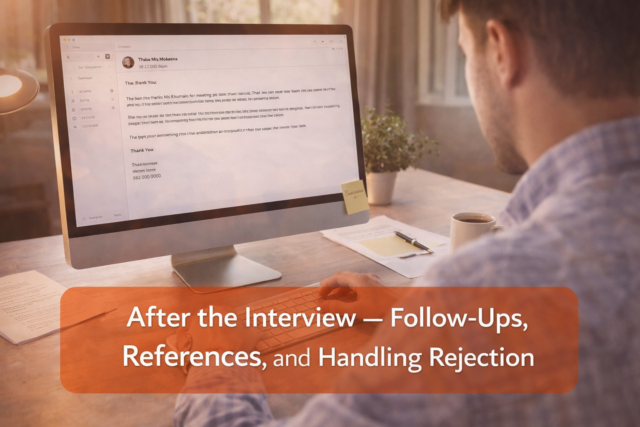
The Interview Is Over. Now What?
You walked out of the interview. Maybe it went brilliantly and you are feeling great. Maybe it was a bit rocky and you are replaying every answer in your head. Maybe you genuinely have no idea how it went, which, by the way, is more common than you think.
Whatever the case, the process is not over yet. What you do in the hours and days after an interview can still influence the outcome, and how you handle the waiting period, both practically and emotionally, matters more than most people realise.
This article covers the post-interview phase in full. The follow-up email, managing your references, dealing with the waiting, handling rejection gracefully, and what to do when things go well and an offer comes through.
Step 1: Send a Thank You Email
We mentioned this briefly at the end of Article 10, but it deserves more attention here because it is one of the most consistently overlooked steps in the entire job search process.
Within 24 hours of your interview, send a brief, professional thank you email to the person or people who interviewed you. If you interviewed with a panel, send individual emails to each person if you have their contact details, or a single email addressed to all of them if not.
This does not need to be long. Three short paragraphs is more than enough.
The first paragraph thanks them sincerely for their time and for the conversation.
The second paragraph briefly reiterates your enthusiasm for the role and, if possible, references one specific thing from the interview that reinforced your interest. This shows that you were genuinely listening and engaged during the conversation, not just waiting for your turn to talk.
The third paragraph simply expresses that you look forward to hearing about the next steps and offers your availability for any follow-up.
Here is a simple example:
Dear Ms Khumalo,
Thank you so much for taking the time to meet with me yesterday. I really enjoyed our conversation and appreciated the opportunity to learn more about the team and the work you are doing.
Hearing about the new client onboarding project you mentioned made me even more excited about the role. The combination of process improvement and stakeholder engagement is exactly the kind of work I find most energising, and I believe my experience at XYZ Company would allow me to contribute meaningfully from early on.
I look forward to hearing about the next steps in the process. Please do not hesitate to reach out if you need any additional information from my side.
Kind regards, Thabo Mokoena 082 000 0000
That is it. Clean, warm, specific, and professional. It takes five minutes to write and it leaves a genuinely positive impression. Most of your fellow candidates will not bother. That alone makes it worth doing.
Step 2: Reflect on Your Performance
Once the thank you email is sent, take some time to reflect honestly on how the interview went. This is not about beating yourself up over anything that did not go perfectly. It is about learning so that you keep getting better.
Ask yourself these questions:
- Which questions did I answer well? What made those answers strong?
- Which questions caught me off guard or did I feel I handled less well? How would I answer them differently next time?
- Was there anything I forgot to mention that I wish I had included?
- How was my body language and composure overall?
- Did I ask good questions at the end? Were there better questions I could have asked?
- What was my overall energy like? Did I come across as genuinely enthusiastic?
Write your reflections down while the interview is still fresh in your mind. If you are called back for a second interview, this record will be invaluable. If this particular opportunity does not work out, these notes become preparation material for your next interview.
Every interview you do makes you better at interviewing, but only if you take the time to reflect and learn from each experience.
Step 3: Notify Your References
If the interview went well and you believe there is a reasonable chance of being shortlisted for an offer, now is a good time to give your references a quick heads up.
Send each of your references a brief message letting them know that you have recently interviewed for a specific role and that they may be contacted in the coming days or weeks. Include the name of the company, the job title, and a brief note about the key skills or qualities that are most relevant to the role.
This is courteous and it also helps your references give a more relevant and informed recommendation. A reference who knows what the employer is looking for will naturally emphasise the most relevant aspects of your performance and character. A reference who is caught completely off guard will give a less focused and less convincing response, even if they think very highly of you.
A simple message like this works well:
Hi [Name],
I hope you are well. I recently had an interview for a [job title] position at [Company Name] and wanted to give you a heads up that they may contact you as a reference in the coming weeks.
The role focuses heavily on [key skills or responsibilities], so if they do reach out, anything you can share about my experience in [relevant area] would be really helpful.
Thank you so much for your ongoing support. I really appreciate it.
[Your name]
Short, considerate, and useful for everyone involved.
Managing the Waiting Period
After a good interview, the waiting period can be genuinely difficult. You are invested in the outcome. You want to know. And the silence can feel loaded with meaning even when it is simply the result of a busy recruiter managing multiple processes at once.
Here is how to handle the wait without losing your mind.
Keep applying for other roles. This is the single most important thing you can do during any waiting period. Do not put your entire job search on hold for one outcome. Keep your applications going, keep your conversations active, and keep your momentum up. This also has a useful psychological effect. When you have other possibilities in play, you are less emotionally dependent on any single outcome, and that makes the waiting far less stressful.
Respect the timeline you were given. If the interviewer told you that you would hear back within two weeks, wait the full two weeks before following up. If no timeline was given, waiting one to two weeks is generally appropriate before sending a polite follow-up.
Follow up once, professionally. If the stated timeline has passed and you have not heard anything, it is entirely appropriate to send a brief, polite follow-up email. Keep it short and positive. Something like:
Dear Ms Khumalo,
I hope you are well. I wanted to follow up on my interview for the [Job Title] position on [date]. I remain very keen on the opportunity and would love to hear about any updates when you have a chance.
Thank you again for your time, and I look forward to hearing from you.
Kind regards, Thabo Mokoena
One follow-up is appropriate. Two is pushing it. Three or more becomes harassment and will cost you the opportunity entirely. If you have followed up once and still heard nothing after another week or so, it is reasonable to assume the role has moved in a different direction and to redirect your energy accordingly.
Do not interpret silence as rejection. Recruitment processes are often delayed by factors that have nothing to do with you. Budget approvals, staff leave, internal restructuring, competing priorities. A lack of communication from the employer is frustrating but it is rarely a deliberate signal. Stay patient and stay professional.
Handling Rejection
Rejection is one of the most emotionally difficult parts of the job search, and it would be dishonest to pretend otherwise. When you have invested time, energy, and hope into an application or an interview, hearing “no” genuinely hurts. Give yourself permission to feel disappointed. That is a healthy and normal response.
But then, when you are ready, here is how to move forward constructively.
Ask for feedback. Not every employer will provide it, and in South Africa many companies have a policy of not giving individual feedback to unsuccessful candidates due to the volume of applications they handle. But it is always worth asking politely. A response like “Thank you for letting me know. I would really appreciate any feedback you are able to share about how I could strengthen my application or interview performance for future opportunities” is professional and shows maturity.
When feedback is offered, receive it gratefully and without defensiveness, even if you disagree with it. The interviewer is giving you a gift when they tell you what did not land well. That information is genuinely useful for your next application.
Reframe rejection as redirection. This might sound like a motivational poster, but there is real truth in it. A job you did not get is often a job that was not right for you, even if you could not see that at the time. The right opportunity is one where your skills, your experience, and your personality are genuinely what the employer needs. When there is a mismatch, both parties are better off finding out before the employment starts rather than after.
Protect your confidence. Repeated rejection can erode your self-confidence over time, especially if your job search is taking longer than you expected. Be proactive about this. Remind yourself regularly of your genuine strengths and achievements. Talk to people who know your value. Keep a small note of positive feedback you have received, whether from interviewers, former managers, or references. When you are feeling low, go back to that note.
Learn and adjust. If you are getting to interview stage but not receiving offers, something in your interview performance may need attention. Go back to Articles 9 and 10 and assess honestly whether there are areas you can improve. Consider practising with a friend or family member. If you are not getting past the application stage, revisit your CV and cover letter with fresh eyes.
Rejection is data, not verdict. It tells you something about the fit between you and that particular opportunity at that particular moment. It does not tell you anything definitive about your worth, your ability, or your future. The job search is a process, and as long as you keep showing up and keep improving, the right match will come.
When You Receive an Offer
All the effort, the applications, the interviews, the waiting, comes down to this moment. An offer.
Before you respond, do the following.
Take a breath and say thank you. Whether the offer comes by phone or email, respond warmly and express genuine gratitude. Then ask for the offer in writing if it has not already been provided. This is completely standard and any legitimate employer will be happy to provide a written offer letter.
Read the offer letter carefully. Check every detail. The job title should match what was discussed. The start date should be workable for you. The salary should be what was agreed or offered. Check the working hours, the leave entitlement, the probation period, and any other conditions of employment. If anything is unclear or does not match your understanding, ask for clarification before signing.
Take reasonable time to consider it. You are entitled to take some time to review an offer properly. 24 to 48 hours is standard. For more senior or complex roles, a slightly longer period may be reasonable. Do not feel pressured to accept on the spot.
Consider whether to negotiate. We will cover salary negotiation in full in Article 13, but for now, know that it is normal and acceptable to negotiate a job offer. Most employers expect it to some degree. You do not need to simply accept the first number you are given.
Once you accept, commit fully. Once you have accepted an offer and signed a contract, honour that commitment. Withdraw any other applications you have in progress and let those employers know professionally and promptly that you are no longer available. This is the respectful and professional thing to do, and the South African professional world can be smaller than you think.
If You Receive Multiple Offers
This is a good problem to have, and it does happen, particularly if you have been running an active, well-managed job search. If you find yourself with more than one offer, give yourself a moment to appreciate that your hard work has paid off. Then think carefully.
Do not make this decision based purely on salary. Consider the full picture. The role itself and whether it excites you. The growth opportunities the company offers. The culture and environment you observed during the process. The commute and practical realities. Your gut feeling about the team and the manager.
A higher salary in a role you will dread going to every day is rarely the better choice in the long run.
The Post-Interview Phase Is Part of Your Brand
Everything you do after an interview, the follow-up email, how you handle the waiting, how you respond to rejection, how you accept an offer, forms part of the professional impression you leave with that employer. South Africa’s professional communities, particularly within specific industries, are often quite well connected. How you conduct yourself throughout the process is noticed and remembered.
Handle every stage with professionalism, warmth, and integrity. Even if a particular opportunity does not work out, the impression you leave might open a door somewhere down the line that you cannot yet see.
Before You Move On, Complete These Steps
The interview is not the end of the process. What you do next can still influence the outcome and improve your future chances.
- Send a Thank You Email
Within 24 hours:- Thank the interviewer for their time
- Reinforce your interest in the role
- Mention one specific part of the conversation
- Reflect on Your Interview
Write down:- What went well
- Questions you struggled with
- What you would improve next time
- Notify Your References
If the interview went well:- Inform your references they may be contacted
- Share details of the role with them
- Keep Applying for Jobs
Do not stop your job search:- Apply for at least 2 more roles
- Keep your pipeline active
- Set a Follow-Up Reminder
If you have not heard back:- Wait 1 to 2 weeks
- Send one polite follow-up email
- Prepare for Possible Next Steps
Be ready for:- A second interview
- Assessments or background checks
- Handle Rejection Professionally
If unsuccessful:- Respond politely
- Ask for feedback (if possible)
- Use it to improve
- Review Your Overall Approach
Ask yourself:- Are you getting interviews?
- Are you converting interviews into offers?
Adjust your approach if needed.
- Prepare for an Offer
Be ready to:- Review an offer carefully
- Take time before accepting
- Consider negotiating if appropriate
- Stay Positive and Consistent
Remind yourself:- Rejection is normal
- Each interview improves your chances
Only move on once you have followed up and reflected on your interview properly.



March 24, 2026
[…] Next up: Article 11, After the Interview, where we cover what to do once the interview is over, how … […]