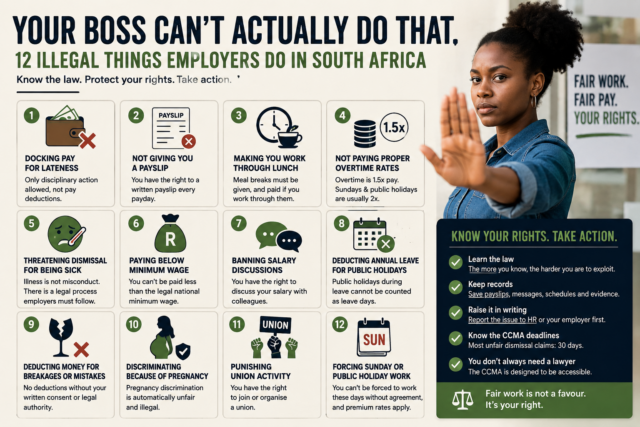
Updated: May 2026 | Based on the BCEA, LRA, EEA, and NMW Act | If you have nodded at least three times reading this list, keep reading to the end.
South Africa has some of the most comprehensive worker protection laws in the world. The Basic Conditions of Employment Act. The Labour Relations Act. The Employment Equity Act. The National Minimum Wage Act. Taken together, these laws cover almost every corner of your working life.
And yet, South African workplaces are full of things happening right now that these laws explicitly prohibit. Some employers know exactly what they are doing. Many genuinely do not know the rules. And most employees, overwhelmed, grateful to have a job, or simply never told otherwise, go along with it because they assume the boss must know what is legal. He often does not.
What follows is a list of 12 things South African employers do constantly that the law says they absolutely cannot do. Each one comes with the specific law it violates and exactly what you can do about it. Not all of these will apply to your situation. But at least three of them probably will.
Important: Knowing your rights and exercising them are two different decisions. This article gives you the knowledge. What you do with it depends on your specific circumstances, your relationship with your employer, and your appetite for a fight. Some of these violations are worth pushing back on firmly. Others are worth filing away for future reference. Only you can make that call.
01 💸 DOCKING YOUR PAY FOR BEING LATE
The classic. The one that has been happening in every industry since forever.
You arrive 20 minutes late on a Tuesday. Fair enough, life happened. Your manager gives you a look. Fine. But then your payslip arrives, and R400 has been deducted. ‘Late deduction,’ it says. Some companies even have sliding scales: 15 minutes late equals half a day docked. One hour late equals a full day.
What they do: Employers deduct money from salaries for late arrival, either informally or as part of a documented policy.
What the law says: Section 34 of the BCEA states that an employer may only make a deduction from an employee’s remuneration with the employee’s written consent, or if it is required or permitted by law or a court order. Docking pay for lateness is not permitted by law. It is not a court order. And if you did not sign a written agreement permitting it, it is an unlawful deduction, full stop. The only legitimate response to lateness is a disciplinary process, not a payroll deduction.
The receipt: Section 34 BCEA. Deductions from remuneration without written consent or legal authority are unlawful. Disciplinary action for lateness is lawful. Pay docking is not.
What to do: Write to HR or payroll requesting the deducted amount be refunded, citing Section 34. If refused, refer a wage dispute to the CCMA. There is no time limit for wage disputes under Section 73A of the BCEA.
02 🧾 NOT GIVING YOU A PAYSLIP
You have a right to see exactly what you are being paid, and exactly what is being taken.
Lots of employees, particularly in smaller businesses, domestic work, retail, and hospitality, receive their salary in cash or by bank transfer with no payslip anywhere in sight. ‘I’ll sort it out at year end’ or ‘we don’t really do payslips here’ or sometimes simply nothing at all. And many employees just accept it, because at least the money came through.
What they do: Employers pay salaries without issuing written payslips, either consistently or sometimes for months at a stretch.
What the law says: Section 33 of the BCEA requires every employer to give every employee a written payslip on the day they are paid. The payslip must show: the employer’s name and address, the employee’s name and occupation, the pay period, the employee’s remuneration in money, the amount and purpose of every deduction made, the actual amount paid, and, where relevant, details of overtime, allowances, and leave pay. This is not optional, and it does not only apply to formal corporate employers. It applies to every employer paying any employee, including domestic workers.
The receipt: Section 33 BCEA. A written payslip is required on payday. No exceptions. No minimum company size requirement. Applies to domestic workers.
What to do: Request your payslips in writing for all outstanding periods. If refused, report to the Department of Employment and Labour (0800 030 007). A labour inspector can require the employer to produce payroll records and issue a compliance order.
03 🍽️ MAKING YOU WORK THROUGH LUNCH WITHOUT PAYING YOU
You are not a machine. The law agrees.
It is 1pm. The office is full. Nobody has moved. The unspoken rule is that lunch is for people who do not care about their jobs. You eat at your desk, reply to emails, take calls, and somehow this does not count as working. Or you are in a retail job and ‘lunch’ means standing near the storeroom for 10 minutes before being called back to the floor. Or you simply never get a break at all because it is busy.
What they do: Employees work through their meal intervals without being paid for that time, or are pressured not to take breaks at all.
What the law says: Section 14 of the BCEA states that an employee who works continuously for more than 5 hours must be given a meal interval of at least 1 continuous hour. The employee must be released from their duties during this interval. If the employee is required to work during the meal interval, that time must be paid. An employer may shorten the meal interval to 30 minutes by written agreement, but it cannot be eliminated entirely. An interval of less than 30 minutes does not count as a meal interval under the Act.
The receipt: Section 14 BCEA. Minimum 1-hour meal interval after 5 continuous hours. Can be reduced to 30 minutes by written agreement only. Work during the interval must be paid. Cannot be waived entirely.
What to do: If you are regularly working through a meal interval that is not being compensated, calculate the hours and raise it as a wage dispute. Systemic refusal to grant meal intervals can also be reported to the Department of Employment and Labour.
04 🌙 PAYING YOU NORMAL RATE FOR OVERTIME
Time and a half is not a favour. It is the law.
You stay late. You come in on Saturday. You do what needs to be done. And at the end of the month, your payslip reflects your normal salary, because apparently ‘overtime is included in your package’ or ‘we don’t pay overtime here’ or the classic ‘everyone works late sometimes, that’s just how it is.’ Your manager says it with such confidence that you start to wonder if maybe you really are just being precious about it.
What they do: Employers require or permit overtime without paying the legally required premium rates, or claim that overtime is ‘included’ in a salary without specifying this clearly.
What the law says: Section 10 of the BCEA limits overtime to 10 hours per week and requires that it be paid at 1.5 times (time and a half) the employee’s normal rate. Work on Sundays (if not an ordinary working day) must be paid at double the normal rate. The BCEA allows an employer to pay overtime via additional time off by agreement, but this must be genuinely agreed upon, and the time off granted must be at the same ratio as the overtime rate (1.5 hours off for every overtime hour worked). The key exception: employees earning above R261,748.45 per year can agree in writing to different overtime arrangements. Below that threshold, the statutory rates apply regardless of what the employment contract says.
The receipt: Section 10 BCEA. Overtime above 45 hours per week: 1.5x rate. Sunday (non-ordinary day): 2x rate. Limit: 10 hours of overtime per week. Employees below the earnings threshold cannot waive these rates in their employment contract.
What to do: Calculate unpaid overtime using your hourly rate. Raise it as a wage dispute in writing. If unresolved, refer to the CCMA or Department of Employment and Labour. Wage disputes for overtime have no time limit under Section 73A.
05 😷 THREATENING TO FIRE YOU FOR BEING SICK
Illness is not misconduct. The law treats them completely differently.
‘If you’re sick again this month, we’re going to have to let you go.’ Said in an office. Said in a WhatsApp message. Said loudly enough for the whole floor to hear. South African workplaces can be brutal about sick leave, particularly in industries like retail, hospitality, and domestic work, where the culture is that you show up or you are replaceable. The threat works because most employees do not know that being dismissed for illness follows an entirely different legal process to being dismissed for misconduct, and it is a process that many employers either do not know exists or deliberately skip.
What they do: Employees are threatened with dismissal for taking sick leave, or are dismissed for illness without any formal incapacity process.
What the law says: The Code of Good Practice: Dismissal (updated and effective 4 September 2025) makes clear that ill health or injury falls under incapacity, not misconduct. Before dismissing an employee for illness, the employer must: investigate the nature and extent of the incapacity, determine the likely duration of incapacity, consider whether reasonable accommodation is possible, consider whether alternative duties or reduced hours could work, and give the employee a genuine opportunity to respond. Dismissing an employee simply for being sick, without this process, is substantively unfair. Threatening dismissal to deter an employee from taking legitimate sick leave is an unfair labour practice.
The receipt: Code of Good Practice on Dismissal (2025). An incapacity process is required before any illness-related dismissal. Threatening dismissal to deter sick leave = unfair labour practice under Section 186(2) LRA.
What to do: If threatened, document it immediately, write down the date, who said what, and any witnesses. If dismissed without a proper incapacity process, refer an unfair dismissal dispute to the CCMA within 30 days of the dismissal date.
06 💰 PAYING YOU BELOW THE NATIONAL MINIMUM WAGE
There is a legal floor. Your wage cannot go below it.
R200 for a full day’s work. R60 for a few hours. ‘Cash in hand, no questions.’ Domestic workers, farmworkers, gardeners, car guards formally employed by parking companies, small retail staff, some of the most vulnerable workers in South Africa, are being paid wages that the law has explicitly prohibited since 2019, and which are reviewed and increased every year. Some employers genuinely do not know. Some know and bank on their employees not knowing.
What they do: Employers pay wages below the current National Minimum Wage, either through ignorance or deliberate exploitation.
What the law says: The National Minimum Wage Act 9 of 2018 sets a binding hourly minimum wage for all employees, reviewed annually. From 1 March 2026, the National Minimum Wage is R30.23 per hour. This applies to domestic workers, farmworkers, and expanded public works programme participants (at a separate lower rate of R16.62 per hour). It is not lawful to pay below these rates. It is not lawful to pay below these rates, even if the employee ‘agreed’ to a lower wage, the NMW cannot be waived by individual agreement.
The receipt: National Minimum Wage Act 9 of 2018. Current NMW: R30.23/hour (from 1 March 2026). Cannot be waived. Applies to ALL employees including domestic workers and farmworkers.
What to do: Calculate the shortfall. Report to the Department of Employment and Labour on 0800 030 007. Employers who underpay can face fines equal to twice the amount owed, or twice the employee’s monthly wage, whichever is greater. You can also refer a wage dispute to the CCMA.
07 🤫 TELLING YOU THAT YOUR SALARY IS CONFIDENTIAL AND YOU CANNOT DISCUSS IT
Wage secrecy is one of the oldest tools for keeping people underpaid. It is also illegal to enforce.
‘What you earn is between you and the company. Discussing your salary with colleagues is a dismissible offence.’ You have seen it in employment contracts. You have heard it in onboarding talks. It gets presented as though it is a perfectly normal professional norm, like not stealing from the till or not sharing client data. It is not. And the reason employers push this rule so hard is exactly why it should make you suspicious.
What they do: Employers include clauses in employment contracts prohibiting employees from discussing or disclosing their salaries to colleagues, and sometimes threaten disciplinary action for doing so.
What the law says: Section 6(4) of the Employment Equity Act prohibits unfair discrimination in terms and conditions of employment, including remuneration. The right to discuss wages is directly linked to the principle of equal pay for work of equal value, a right you cannot exercise if you are forbidden from knowing what your colleagues earn. The Constitutional Court and Labour Courts have consistently found that blanket salary confidentiality clauses that prevent employees from ever discussing pay are unenforceable and contrary to the spirit of the EEA. Disclosing your own salary to a colleague is protected speech. An employer cannot lawfully discipline you for it.
The receipt: Section 6(4) Employment Equity Act. Equal pay for work of equal value. You have the right to know if you are being paid less than a colleague doing equivalent work. Clauses prohibiting salary disclosure are unenforceable.
What to do: If disciplined for discussing your salary with a colleague, refer an unfair labour practice dispute to the CCMA. If you discover you are earning less than a colleague of a different race, gender, or age doing the same work, you have an equal pay discrimination claim under the EEA.
08 🏖️ DEDUCTING LEAVE DAYS FOR A PUBLIC HOLIDAY
A holiday is a holiday. It does not come out of your annual leave.
You take a week off over Easter. You come back and check your leave balance. Five days gone, including Good Friday and Family Day. Your employer counted the public holidays as part of your leave days. Which means your actual rest time was three days, not five, but your leave balance is four days lighter than it should be. This happens constantly. It is presented as standard practice. It is not.
What they do: Employers count public holidays as annual leave days when they fall within an employee’s approved leave period, effectively stealing leave days that the employee is legally entitled to keep.
What the law says: Section 20(11) of the BCEA is explicit: an employer may not require an employee to take annual leave during a public holiday. A public holiday that falls within a period of annual leave does not count as an annual leave day. The employee is entitled to the public holiday in addition to their annual leave days. If Easter includes two public holidays and you take 5 calendar days off, only 3 working days should be deducted from your leave balance, not 5.
The receipt: Section 20(11) BCEA. Public holidays cannot be counted as annual leave days. If they fall within your leave, those days must remain in your balance.
What to do: Check every leave period against the public holidays calendar. If days have been incorrectly deducted, request in writing that they be reinstated. If refused, refer a wage/leave dispute to the CCMA or the Department of Employment and Labour.
09 📋 DEDUCTING MONEY FOR BREAKAGES, MISTAKES, OR TILL SHORTAGES WITHOUT YOUR WRITTEN CONSENT
You dropped a tray. You made an error. The till is R50 short. Suddenly, it is your problem.
You work in a restaurant, and a plate gets broken. R80 off your wages. You are a cashier, and your till comes up short at the end of the shift. R150 deducted ‘until we sort it out.’ You made an error in a report that cost the company money. Your bonus is docked. This practice is so normalised in certain industries, hospitality, retail, and domestic work, that employees do not think to question it. They should.
What they do: Employers deduct money from wages for breakages, errors, till shortages, damaged equipment, or customer complaints, without the employee’s written consent to such deductions.
What the law says: Section 34 of the BCEA permits deductions only with the employee’s written consent or where required by law or a court order. An employee’s written agreement to a deduction scheme at the time of hiring does not constitute valid consent to any specific deduction; it must be contemporaneous and specific to the particular amount being deducted. Furthermore, Section 34(2) prohibits any deduction that would reduce the employee’s pay below the National Minimum Wage. Even if you agree to a deduction in writing, it cannot take your pay below R30.23 per hour.
The receipt: Section 34 BCEA. Deductions for breakages or errors require specific written consent at the time. Cannot reduce pay below NMW (R30.23/hr). Pre-signed blanket deduction agreements do not override this.
What to do: Refuse to sign any blanket deduction authorisation forms at the time of hiring, they are frequently unlawful in scope. For past deductions, calculate what was taken and demand it back in writing. Refer to the CCMA as a wage dispute if not returned.
10 🤱 TREATING PREGNANCY AS A PROBLEM THAT NEEDS TO BE MANAGED
Pregnancy is not a performance issue. Penalising it is discrimination.
She announces her pregnancy. Within weeks, suddenly her performance reviews go from ‘meeting expectations’ to ‘areas for improvement.’ She is excluded from the team lunch where the big client announcement happens. Her contract, which was due for renewal, does not get renewed. Or she comes back from maternity leave to find that her role has been ‘restructured away.’ Coincidences, all of them. Sure.
What they do: Employers demote, retrench, fail to renew contracts, or otherwise disadvantage employees because of pregnancy or maternity leave.
What the law says: Pregnancy is a listed ground of unfair discrimination under Section 6 of the Employment Equity Act. Dismissal on grounds of pregnancy, including constructive dismissal or failure to renew a fixed-term contract where the non-renewal is connected to pregnancy, is an automatically unfair dismissal under Section 187 of the LRA. This means the Labour Court may award up to 24 months’ remuneration as compensation, without needing to prove procedural unfairness. The employer cannot use ‘restructuring’ or ‘operational requirements’ as cover if the timing is suspicious and the real reason is the pregnancy.
The receipt: Section 6 EEA (discrimination on grounds of pregnancy) and Section 187 LRA (automatically unfair dismissal). Compensation up to 24 months. No procedural shortcut available to the employer.
What to do: Document everything, every performance review, every communication, every change in treatment that coincides with the announcement of your pregnancy. Refer an automatically unfair dismissal dispute to the CCMA within 30 days of dismissal, or an unfair labour practice dispute within 90 days if still employed.
11 🔇 FIRING YOU FOR JOINING A TRADE UNION OR TALKING TO YOUR COLLEAGUES ABOUT FORMING ONE
Organising at work is a constitutional right. Retaliating against it is one of the worst things an employer can do.
You start talking to your colleagues about your rights. You mention the union. You attend one meeting. And suddenly, a disciplinary process that was never coming before is now running at full speed. Coincidence? Your manager says so. The law says otherwise.
What they do: Employers dismiss or threaten employees for trade union membership, union activities, or for exercising their rights to organise collectively.
What the law says: Section 5 of the LRA prohibits employers from prejudicing an employee in any way because of that employee’s trade union membership, participation in lawful union activities, or exercise of any right under the LRA. Section 187 makes dismissal for these reasons automatically unfair, meaning the employer cannot cure the dismissal with a procedurally perfect process. It is unfair regardless of the procedure. Compensation can be up to 24 months’ remuneration. The right to organise and to join a trade union is also protected in Section 23 of the Constitution. An employer who fires someone for speaking to their colleagues about a union is taking on the Constitution itself.
The receipt: Section 5 LRA (protection of employees). Section 187 LRA (automatically unfair dismissal). Section 23 of the Constitution. Compensation up to 24 months. No procedural fix available to the employer.
What to do: Refer an automatically unfair dismissal dispute to the CCMA within 30 days. Contact the relevant trade union, they deal with these cases and will often assist at no cost to the employee.
12 📵 FORCING YOU TO WORK ON A SUNDAY OR PUBLIC HOLIDAY WITHOUT YOUR AGREEMENT
You are allowed to have a day off. The law says so, and the law requires they pay extra if you do work.
‘You’re on the roster this Sunday.’ ‘I need you in on Good Friday.’ ‘Everyone works public holidays here, it’s in your contract.’ Maybe it is in your contract. But maybe it is not, and your manager is hoping you assume it must be, because that assumption has worked on everyone else. Working on Sundays and public holidays is your choice unless you have specifically agreed otherwise. And even if you have agreed, the pay rates change.
What they do: Employers require employees to work on Sundays or public holidays without a genuine agreement, or pay normal rates for this work instead of the legally required premium.
What the law says: Section 15 BCEA: work on Sundays must be paid at double the employee’s normal rate unless the employee ordinarily works on Sundays, in which case time-and-a-half applies. Section 18 BCEA: An employer may not require an employee to work on a public holiday except by agreement. If they do work, they must receive the greater of double their daily wage, or their daily wage plus the amount earned for hours worked. Section 18(1) is the agreement requirement, if your contract says you may be required to work on public holidays, that is the agreement. If your contract is silent, the employer needs your specific consent each time.
The receipt: Section 15 BCEA (Sunday rates). Section 18 BCEA (public holiday agreement and double pay). No agreement, no lawful requirement to work. If you work, double pay is the floor.
What to do: Calculate the unpaid premium pay for Sundays and public holidays worked. Raise as a wage dispute in writing. Refer to the CCMA or Department of Employment and Labour if unresolved. Section 73A wage disputes have no time limit.
So What Do You Do With This?
You have just read 12 things that are happening in workplaces across South Africa right now. Some of them are happening to you. Some of them have happened to you, and you didn’t know at the time. Some of them will happen to you in the future.
Here is the honest answer to what you should do with this information:
- Know it first. Most violations persist because employees do not know their rights. Now you do. Knowledge alone changes how you carry yourself in a workplace, you stop accepting things because they are ‘just how it is’ and start recognising them for what they are.
- Document everything. If something on this list is happening to you, start keeping records now. Write down dates, what was said, who witnessed it. Save payslips. Screenshot WhatsApps. Keep copies at home, not just on a company device. Evidence is everything.
- Raise it in writing first. Before going to the CCMA or the Department of Labour, give your employer the opportunity to fix it. Put your concern in writing, email is fine, citing the specific section of the law. Many employers will comply immediately once it is clear you know what you are talking about. Some won’t. But the paper trail helps either way.
- Know your deadlines. Unfair dismissal disputes must be referred to the CCMA within 30 days of dismissal. Unfair labour practice disputes: 90 days. Wage disputes: no time limit. If you are not sure what category your situation falls into, go to the CCMA anyway. They will help you figure it out.
- You do not need a lawyer. The CCMA is free and designed to be used without legal representation. You can walk in, complete a referral form, and begin a process that has genuine enforcement power. The number for the CCMA is 0861 16 1616. The Department of Employment and Labour’s toll-free line is 0800 030 007.
Final thought: The law is only as useful as the people who know it. These protections were fought for by South African workers over decades. They exist because someone before you decided that these things were wrong and organised to make the law say so. Using your rights is not being difficult. It is being the kind of employee who makes workplaces better for everyone who comes after you.
Related posts:


LEGAL CONTENT DISCLAIMER
The information contained on this website is simply aimed at providing readers with guidance on labour law in South Africa. This information has not been provided to meet the individual requirements of a specific individual. Bizcraft will always suggest that legal advice be obtained to address a person’s unique circumstances. It is important to remember that the law is constantly changing and although Bizcraft strives to keep the information up to date and of high quality, it cannot be guaranteed that the information will be updated and/or be without errors or omissions. As a result, Bizcraft will under no circumstances accept liability or be held liable, for any innocent or negligent actions or omissions which may result in any harm or liability flowing from the use of or the inability to use the information provided.