Last updated: April 2026 | Reflects the Van Wyk Constitutional Court ruling of 3 October 2025 | Based on: BCEA Sections 20–27, LRA Section 186, and CCT 308/23 [2025] ZACC 20 | For: All South African employees and their employers
Leave is one of the most searched employment law topics in South Africa — and one of the most misunderstood. Google’s 2025 search trend analysis confirms that questions about sick leave, annual leave, family responsibility leave, and maternity leave consistently top the list of what South African employees and employers are looking for. The confusion costs people money, causes unnecessary workplace conflict, and — in some cases — results in employees accepting far less than the law guarantees them.
This guide covers every type of statutory leave in South Africa, the rules that apply to each, the questions people ask most often, and the landmark Van Wyk Constitutional Court ruling of October 2025 — which completely changed parental leave law and which most South Africans, including many employers, are still unaware of.
All figures and rules reflect the law as it stands in April 2026.
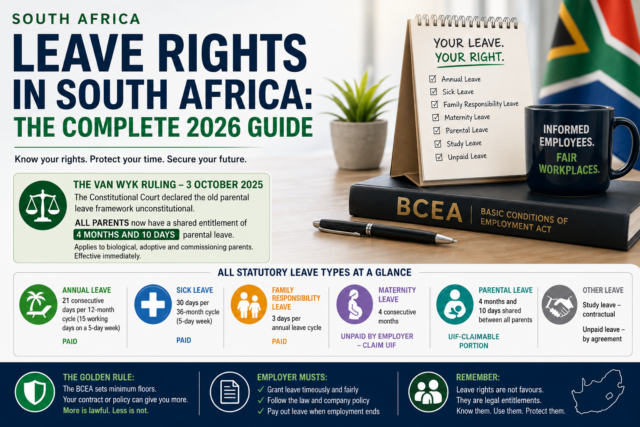
The Van Wyk ruling — effective immediately: On 3 October 2025, the Constitutional Court handed down its judgment in Van Wyk and Others v Minister of Employment and Labour (CCT 308/23). It declared the old parental leave framework unconstitutional and, with immediate interim effect, granted ALL parents — biological, adoptive, and commissioning — shared parental leave of 4 months and 10 days. This applies right now, before Parliament passes remedial legislation. If you are an employer who has not updated your leave policy, or an employee who was denied parental leave under the old rules, read the dedicated section in this article.
All Leave Types at a Glance
| Leave Type | Amount | Paid? | BCEA Section | Key Condition |
| Annual leave | 21 consecutive days per 12-month cycle (15 working days on a 5-day week) | Yes — full pay | Section 20 | Must work more than 24 hours/month. Must be taken within 6 months after cycle ends. |
| Sick leave | 30 days per 36-month cycle (5-day week); 36 days for 6-day week | Yes — full pay (with valid certificate when required) | Section 22 | First 6 months: 1 day per 26 days worked. Full entitlement from month 7. |
| Family responsibility leave | 3 days per annual leave cycle | Yes — full pay | Section 27 | Must work 4+ days/week and be employed 4+ months. Specific qualifying events only. |
| Maternity leave | 4 consecutive months | Unpaid by employer — claim UIF (38–60% of salary, capped) | Section 25 | Starts up to 4 weeks before expected birth. Cannot return within 6 weeks of birth. |
| Parental leave (Van Wyk ruling — effective 3 Oct 2025) | 4 months and 10 days shared between all parents | UIF-claimable portion (pending legislation) | Section 25B (as amended by ConCourt) | Applies to biological, adoptive, and commissioning parents. Shared as they choose. |
| Study leave | No statutory minimum — contractual only | Depends on contract | None | Check your employment contract. No legal minimum requirement. |
| Unpaid leave | No statutory entitlement — by agreement only | No | None | BCEA does not create a right to unpaid leave. Employer may offer it when paid leave is exhausted. |
The golden rule: The BCEA sets minimum floors. Your employment contract, company policy, or collective agreement may provide more generous leave than the statutory minimum. More is lawful. Less is not. If your contract gives you 20 days annual leave instead of 15, the 20 days is what applies. If it gives you 10 days, you are legally entitled to the 15-day minimum regardless of what the contract says.
Annual Leave: Everything You Need to Know
Annual leave generates more CCMA disputes and more workplace misunderstandings than almost any other leave type. The rules are clear in the BCEA but frequently misapplied. Here is the complete picture:
| Question | The Rule | What It Means Practically |
| How many days am I entitled to? | 21 consecutive days per annual leave cycle (12 months with the same employer). For a 5-day week: 15 working days. For a 6-day week: 18 working days. | If your cycle started on 1 March 2025, by 28 February 2026 you are entitled to 15 working days off (assuming 5-day week). This is the legal minimum. Your contract may give you more. |
| When does leave accrue? | Leave accrues continuously throughout the cycle. Alternative method (by agreement): 1 day per 17 days worked, or 1 hour per 17 hours worked. | You do not need to wait 12 months to take any leave. You can take leave as it accrues, provided the employer agrees to the timing. |
| When must leave be taken? | The employer must grant annual leave no later than 6 months after the end of the annual leave cycle. The employer may determine the timing, but may not act unreasonably. | If your cycle ended 28 February 2026, your leave must be granted by 31 August 2026. If the employer has not granted it by then, you can demand to take it and they cannot refuse. |
| Can the employer refuse annual leave? | Yes — but not unreasonably. The employer may schedule leave to suit operational requirements. | An employer can say ‘not in December’ if December is their busiest period. They cannot simply never grant leave or keep deferring it indefinitely. |
| Can leave be carried over? | Yes — leave from the previous cycle can carry over. But the employer must grant the carried-over leave within 6 months of the new cycle starting. | If you have unused leave from the 2024/2025 cycle, your employer must allow you to take it before September 2026. After that, it lapses — but only if the employer had given you a reasonable opportunity to take it. |
| Can leave be paid out instead of taken? | No — not while you are employed. Annual leave cannot be substituted with cash while the employment relationship continues. | Your employer cannot offer you payment in lieu of leave and call it done. You must physically take the time off. Exception: when employment ends (resignation, retrenchment, dismissal), all accrued leave must be paid out. |
| What happens to leave when I resign or am retrenched? | All unused accrued annual leave must be paid out at your normal daily rate. This applies to both the current cycle and any carried-over leave. | If you have 10 unused days when you leave, you receive 10 days’ pay on top of your final salary. This cannot be waived in your employment contract. |
| Does a public holiday during leave count against my leave days? | No. Public holidays are excluded from annual leave. If a public holiday falls during your leave period, that day is not counted as a leave day. | You take leave from Monday 21 April to Friday 25 April. Freedom Day on 27 April — wait, if it fell within that period it would not count. Check your leave carefully against the public holidays calendar each time. |
| Can my employer make me take leave? | Yes — the employer may require employees to take leave during a period of reduced operation (e.g. a factory shutdown over Christmas). | A mandatory shutdown over the December–January period is common and lawful, provided the employer gives reasonable notice and the leave days used are from the employee’s legal entitlement. |
The most common annual leave myths — debunked
- Myth: ‘My leave expires if I don’t take it by year-end.’ The employer must grant leave within 6 months after the cycle ends. It does not automatically lapse on 31 December if that is not when your cycle ends. Your cycle runs from your start date, not the calendar year.
- Myth: ‘My employer can make me take leave whenever they want.’ The employer may determine the timing, but must act reasonably and consider both operational needs and the employee’s interests. Courts have found ‘unreasonable’ timing decisions to be BCEA contraventions.
- Myth: ‘I can cash out my leave instead of taking it.’ No. While employed, annual leave must be taken as actual time off. Payment in lieu is only allowed at termination.
- Myth: ‘Part-time employees don’t get annual leave.’ Wrong. Any employee working more than 24 hours per month qualifies for annual leave. Accrual is proportional to days worked.
Sick Leave: The 3-Year Cycle Explained
Sick leave in South Africa operates on a 3-year cycle, not an annual one. This is the source of most sick leave confusion in South African workplaces. Here is everything you need to know:
| Question | The Rule | Practical Example |
| How much sick leave am I entitled to? | One full sick leave cycle = 36 months (3 years). In that cycle, an employee on a 5-day week gets 30 days; 6-day week: 36 days. This equals the number of days they would normally work in 6 weeks. | You work Monday to Friday. Your sick leave cycle gives you 30 days over 3 years. You do not get 10 days per year — you have 30 days to use however you need them across the full 3 years. |
| What happens in the first 6 months? | During the first 6 months of employment, sick leave is limited to 1 paid day for every 26 days worked. | You start a new job in January. By the end of June (6 months), you have worked approximately 130 days, entitling you to 5 paid sick days in that period. From month 7 onwards, the full 30-day cycle entitlement kicks in. |
| When does a new sick leave cycle start? | A new cycle begins on the first day of the 7th month of the employment relationship, and then every 36 months thereafter. | You started working 1 February 2023. Your first sick leave cycle runs from 1 August 2023 to 31 July 2026. On 1 August 2026 a new 30-day cycle begins. |
| Do I need a doctor’s certificate? | Yes — for absences longer than 2 consecutive days, or more than twice in any 8-week period. For a single day’s absence once, or a second isolated instance in 8 weeks: no certificate required by law. | You are sick Monday and Tuesday. If you return Wednesday, no certificate is legally required for those 2 days. But if you stay off Wednesday as well (3 consecutive days), a certificate is required from the employer’s perspective. |
| Can my employer insist on a certificate for a single day? | Your contract or company policy may require a certificate even for a single day’s absence. This is lawful — the BCEA sets a floor, not a ceiling. Employer policies can be stricter. | Check your employment contract and HR policy. If it states ‘certificate required for any absence’, that is enforceable. The BCEA minimum does not override a stricter contractual requirement. |
| Can an employer deduct pay for sick leave if I have no certificate? | If the employer requires a certificate and you fail to produce one, the employer may treat the absence as unpaid leave. This is lawful if the certificate requirement was communicated clearly. | You call in sick on a Monday. Your policy requires a certificate for all absences. You do not provide one. Your employer can withhold pay for that day. Ensure you know your company’s policy before assuming. |
| What happens when my sick leave is exhausted? | The employer may allow or require you to take unpaid leave. The employer cannot dismiss you simply for being sick — dismissal based on illness requires a formal incapacity process. | You have used all 30 days in your sick leave cycle and you fall ill again. Your employer cannot fire you on the spot. They must follow the incapacity procedure: assess your condition, consider alternatives, and follow a fair process before any dismissal. |
| Is sick leave separate from annual leave? | Yes — entirely separate. An employer may not require you to use annual leave instead of sick leave when you are ill. The BCEA expressly prohibits substituting sick leave with annual leave. | You are sick for 5 days. Your employer tells you to use your annual leave because your sick leave is exhausted. This is unlawful if you are genuinely ill and have not yet exhausted your sick leave cycle. If your sick leave is truly used up, unpaid leave applies — not forced annual leave deduction. |
The ‘one day per 26 days’ first-6-months rule — why it exists: The limited sick leave entitlement in the first 6 months exists to prevent new employees from exhausting leave immediately after starting work. It is not a punitive measure — it is a balance between employee protection and employer risk during the probationary period. From month 7, you have full access to the 30-day sick leave cycle entitlement.
Sick leave and the incapacity process
If an employee is genuinely ill for an extended period and exhausts their sick leave, the employer cannot simply dismiss them. The Code of Good Practice: Dismissal (effective 4 September 2025) requires a formal incapacity process: the employer must investigate the nature and extent of the incapacity, determine whether the employee is likely to recover and when, consider whether alternative or lighter duties are possible, and only proceed to dismissal after a fair process that includes giving the employee an opportunity to respond.
Short-term repeated absence is dealt with differently from long-term incapacity. Both require a proper process. ‘You’ve been sick too many times’ without a formal incapacity investigation is not a lawful basis for dismissal in South Africa.
Family Responsibility Leave: 3 Days That Are Frequently Stolen
Family responsibility leave is the most commonly violated leave entitlement in South Africa. Employers routinely deduct it from annual leave balances, deny it for qualifying events, or simply fail to tell employees it exists. Here is the complete picture:
| Aspect | The Rule | Notes and Common Mistakes |
| Entitlement | 3 days per annual leave cycle. Domestic workers: 5 days per cycle. | Family responsibility leave runs alongside the annual leave cycle. It does not roll over. Any unused days lapse at the end of the cycle — they cannot be accumulated. |
| Who qualifies? | Employees who have worked 4+ months for the same employer AND work 4+ days per week for that employer. | If you work 3 days a week, you do not qualify. If you are in your first 4 months, you do not qualify. This is a common source of confusion among part-time and new employees. |
| Qualifying events — child-related | Birth of your child (you are the parent). Illness of your child. | Death of a child is covered under bereavement events below. Illness must be your own child — not a sibling, parent, or other relative. |
| Qualifying events — bereavement | Death of: spouse or life partner; parent or adoptive parent; grandparent; child or adopted child; grandchild; or sibling. | The list is specific and exhaustive. If the deceased is a cousin, aunt, uncle, or close friend — however devastating personally — family responsibility leave does not apply. You would need to take annual leave or unpaid leave. |
| Can leave be taken as a half day? | Yes. The BCEA explicitly provides that an employee can take family responsibility leave as a half-day if that is all that is required. | If your child is sick and you only need to take them to the doctor in the morning, you can request a half-day of family responsibility leave. You are not forced to take the full day. |
| Can the employer require proof? | Yes. The employer may require documentary proof of the event: a medical certificate for a sick child, a death certificate or funeral programme for bereavement, or a birth certificate for a new child. | Comply with the request. Refusing to provide proof when reasonably requested may allow the employer to treat the absence as unpaid or unauthorised. Keep documents. |
| Can the employer refuse? | No — not unreasonably. If you have the entitlement and the reason qualifies, the employer must grant the leave. | An employer who refuses valid family responsibility leave may face a CCMA complaint for an unfair labour practice. Document the refusal in writing. |
| Does it affect annual leave? | No. Family responsibility leave is in addition to annual leave. It cannot be deducted from annual leave days. | A very common employer mistake is to deduct family responsibility leave from the annual leave balance. This is unlawful. They are entirely separate entitlements. |
The most common violation: Deducting family responsibility leave from the annual leave balance is unlawful. They are entirely separate entitlements. If your employer has been doing this, you are entitled to have those days reinstated. Put it in writing, cite Section 27 of the BCEA and Section 20 (annual leave), and request the correction. If unresolved, report to the Department of Employment and Labour.
The Van Wyk Ruling: How Parental Leave Changed on 3 October 2025
This is the most significant change to South African employment law in years — and surveys confirm that the majority of South African employers have not yet updated their leave policies to reflect it. If you are a parent, a pregnant employee, or an HR professional, this section is essential reading.
The Constitutional Court in Van Wyk and Others v Minister of Employment and Labour [2025] ZACC 20 found that the old BCEA parental leave framework was unconstitutional because it discriminated unfairly between biological mothers and all other parents — giving mothers 4 months while fathers received 10 days, and adoptive or commissioning parents received 10 weeks. This was found to violate the Constitution’s equality provisions and the right to dignity.
| Aspect | Before Van Wyk (old position) | After Van Wyk (from 3 October 2025) |
| Who the ruling affects | Biological mothers, biological fathers, adoptive parents, commissioning parents. | All parents in any parental relationship — biological, adoptive, and commissioning — regardless of gender. |
| Maternity / birth mother leave | 4 months unpaid maternity leave for the birth mother. | Birth mother: still entitled to 4 months. She may still commence up to 4 weeks before the expected birth date. She may not return within 6 weeks of the birth unless medically cleared. |
| Total shared parental leave | Birth mother: 4 months. ‘Other parent’: 10 days only. Adoptive/commissioning parents: 10 weeks. | ALL parents collectively: 4 months and 10 days to share between them as they choose. This is the landmark change. |
| Can parents take leave simultaneously? | No clear provision for this. | Yes — the leave may be taken consecutively (one after the other) or simultaneously (at the same time). Parents decide. |
| Single employed parent | Not specifically addressed. | If only one parent is employed, that parent is entitled to the full 4 months and 10 days alone. |
| UIF for parental leave | Only mothers and 10-day ‘other parent’ leave qualified for UIF. The rate was 38–60% of salary, capped at R17,712/month. | The Constitutional Court declared the UIF provisions unconstitutional to the extent they discriminated. UIF parity for all parents is the direction. Pending Parliament’s remedial legislation (due within 36 months of 3 October 2025). |
| Is this law right now? | No longer applies. | Yes — with immediate effect from 3 October 2025 as interim relief. Employers must comply now, even before Parliament passes the remedial legislation. |
| What about the Labour Law Amendment Bill? | Not yet applicable. | Parliament has 36 months (from October 2025) to pass remedial legislation. The Labour Law Amendment Bill 2025/2026 is expected to give this permanent legislative effect. |
What this means for your workplace right now: If you are an employer, your leave policy must be updated to reflect the Van Wyk ruling. ‘Father’s leave’ or ‘paternity leave’ of 10 days is no longer the lawful position. All parents are entitled to share 4 months and 10 days. If you are a parent who was denied adequate parental leave after 3 October 2025, you have a potential CCMA claim for an unfair labour practice.
The Labour Law Amendment Bill 2025/2026
Parliament has 36 months from 3 October 2025 to pass remedial legislation. The Labour Law Amendment Bill 2025/2026 is the expected vehicle. Until it passes, the Constitutional Court’s interim directions are law. Employers must comply with the Van Wyk ruling now, not when the bill is passed. Any employer argument that they are ‘waiting for the legislation’ is not a lawful basis for non-compliance.
Maternity Leave: The Birth Mother’s Rights
Despite the Van Wyk ruling expanding rights for all parents, the birth mother retains specific and important protections under the BCEA that go beyond simple leave entitlement. These reflect both her physical recovery needs and the health of the newborn:
| Question | Answer |
| How long is maternity leave? | 4 consecutive months. The employee may start leave up to 4 weeks before the expected birth date. She may not return to work within 6 weeks of the birth. |
| Is maternity leave paid? | The BCEA does not require the employer to pay during maternity leave. The employee claims UIF maternity benefits — 38% to 60% of average monthly salary over the past 24 months, capped at a salary of R17,712 per month. This pays out for up to 121 days (approximately 4 months). |
| Can the employer force the employee to leave earlier than planned? | No. The employee decides when within the permitted window (not later than 4 weeks before birth) to start leave. The employer cannot force early departure. |
| Can the employee return before 6 weeks if she wants to? | Only if a medical practitioner or midwife certifies it is safe to do so. Without medical clearance, the employer is prohibited from allowing (or requiring) her to return within 6 weeks of birth. |
| What happens to the employee’s job while on maternity leave? | The employee has the right to return to her same job or, if that is not reasonably practicable, an equivalent job on terms no less favourable than before she left. |
| Can an employer retrench an employee during maternity leave? | Retrenchment during maternity leave is not automatically prohibited, but it is extremely high risk legally. Pregnancy and maternity leave are protected grounds under the Employment Equity Act. Using maternity leave as a cover for dismissal is an automatically unfair dismissal. |
| What if the pregnancy ends in miscarriage or stillbirth? | If the pregnancy ends after the 28th week, the employee is entitled to 6 weeks’ maternity leave from the date of the event. UIF pays for this period (42 days). |
| Does maternity leave affect annual leave? | No. Maternity leave does not reduce the annual leave entitlement. Annual leave continues to accrue during maternity leave. |
Claiming UIF for maternity leave — the essentials
The employer does not pay during maternity leave in most cases. The income comes from UIF. The key figures:
- UIF maternity benefit rate: 38% to 60% of your average salary over the past 24 months, depending on your income level. Lower earners receive a higher replacement rate.
- Monthly salary cap: R17,712 per month. If you earn more, UIF only calculates benefits on R17,712.
- Maximum payment period: 121 days (approximately 4 months).
- Application: Apply via uFiling (ufiling.co.za) or at your nearest Department of Employment and Labour office. Apply as soon as maternity leave begins — do not wait.
- Required documents: UI-19 form from employer, last 6 months’ payslips, ID, banking details, UI-2.3 (maternity leave form), and UI-2.8 (application for benefits).
Unpaid Leave: What the Law Actually Says
Here is something that surprises many employees: the BCEA does not create a right to unpaid leave. There is no section of the Act that entitles an employee to request unpaid leave and have the employer grant it.
What the BCEA does say is that once paid leave entitlements are exhausted, the employer may allow or require the employee to take unpaid leave. This means unpaid leave is at the employer’s discretion — it is not an automatic right. An employer who refuses an unpaid leave request is not automatically in breach of any law, unless:
- The refusal constitutes unfair discrimination (for example, refusing unpaid leave for religious observance when comparable leave for other reasons is granted)
- A collective agreement or company policy creates an entitlement to unpaid leave
- The employee has a contractual entitlement to unpaid leave
If you need extended time off beyond your paid leave entitlements, apply for it formally in writing and negotiate with your employer. There is no guarantee of approval, but many employers will accommodate reasonable requests — especially where the alternative is resignation.
When Your Employer Violates Your Leave Rights: What to Do
The table below covers the most common leave rights violations in South African workplaces and the correct response to each:
| Violation | What the Law Says | What to Do |
| Employer refuses to grant annual leave | Section 20 BCEA. The employer must grant leave within 6 months after the end of the cycle. Refusal is a contravention of the BCEA. | Request in writing citing Section 20. If refused, report to the Department of Employment and Labour (0800 030 007) or refer a dispute to the CCMA. |
| Employer deducts sick leave from annual leave balance | Unlawful. Sick leave and annual leave are completely separate entitlements under the BCEA. | Write to HR, citing Section 22 (sick leave) and Section 20 (annual leave). Request that the annual leave days be reinstated. Escalate to the Department of Employment and Labour if unresolved. |
| Employer refuses family responsibility leave for a qualifying event | Unlawful if the employee meets the eligibility criteria. This constitutes an unfair labour practice under Section 186(2) of the LRA. | Submit a written request with documentary proof. If refused, refer an unfair labour practice dispute to the CCMA within 90 days. |
| Employer fails to pay out accrued leave on resignation or retrenchment | Section 21 BCEA requires all accrued annual leave to be paid out at termination. This is a statutory debt — no waiver is enforceable. | Demand payment in writing. This is a wage dispute with no time limit for CCMA referral under Section 73A of the BCEA. The claim is for the monetary value of unpaid leave days. |
| Employer dismisses employee for being sick | Dismissal for illness without following the incapacity procedure is substantively unfair. The employer must investigate, offer reasonable accommodation, and consider alternatives before dismissal. | Refer an unfair dismissal dispute to the CCMA within 30 days of the dismissal date. Keep all medical documentation. |
| Employer does not allow maternity return to same role | Section 25(3) BCEA requires reinstatement to the same job or equivalent role. Failure is an automatically unfair dismissal if linked to pregnancy or maternity. | Refer an automatically unfair dismissal dispute to the CCMA within 30 days. Compensation may be up to 24 months’ remuneration. |
| Employer denies parental leave under Van Wyk ruling | As of 3 October 2025, all parents are entitled to shared parental leave of 4 months and 10 days. Denial is unconstitutional and unlawful. | Request leave in writing, citing the Van Wyk judgment (CCT 308/23, 3 October 2025). If refused, refer to the CCMA as an unfair labour practice. |
The Department of Employment and Labour’s toll-free number is 0800 030 007. Labour inspectors have the authority to inspect payroll records, issue compliance orders, and impose penalties on employers who violate the BCEA. For disputes that the Department cannot resolve, the CCMA provides free conciliation and arbitration.
Frequently Asked Questions
How many leave days am I entitled to in South Africa?
Annual leave: 21 consecutive days (15 working days on a 5-day week) per 12-month cycle. Sick leave: 30 days over a 36-month cycle. Family responsibility leave: 3 days per year. Maternity leave: 4 months. Parental leave (Van Wyk ruling): all parents share 4 months and 10 days. These are minimums — your contract may give more.
Can my employer refuse sick leave?
If you are genuinely ill and have sick leave remaining in your cycle, your employer cannot refuse to grant it. They may require a medical certificate for absences longer than 2 consecutive days or more than twice in 8 weeks. If your sick leave is exhausted, they may put you on unpaid leave rather than paid sick leave — but they cannot simply refuse and dock annual leave without your agreement.
Does unused sick leave pay out when I resign?
No. Unlike annual leave, sick leave is not paid out on termination. It operates on a ‘use it or lose it’ basis. Only unused annual leave must be paid out when employment ends.
Can I take annual leave during my notice period?
Yes, but only by agreement with the employer. The employer can grant you annual leave during your notice period if both parties agree. The employer cannot force you to use your annual leave as your notice period without your consent.
What is the difference between family responsibility leave and compassionate leave?
Family responsibility leave is a statutory entitlement under Section 27 of the BCEA — it is the 3 days per year for specific qualifying events. Compassionate leave is a non-statutory, company-specific policy that some employers provide voluntarily for bereavement or family emergencies. If your company has a compassionate leave policy that is more generous than family responsibility leave, the better provision applies.
Can my employer make me take annual leave over the December shutdown?
Yes, if the shutdown is a genuine operational requirement and reasonable notice is given. Many South African companies close between Christmas and New Year and require employees to use their annual leave during this period. This is lawful. The employer cannot, however, require you to take leave during this period if you do not have leave days available — they would need to pay you or agree to unpaid leave.
Does annual leave accrue while I am on maternity leave?
Yes. Annual leave continues to accrue during maternity leave. When you return from maternity leave, your annual leave balance should reflect the days that accrued during your absence. An employer who freezes your annual leave accrual during maternity leave is in breach of the BCEA.
What parental leave am I entitled to as a father in 2026?
Following the Van Wyk Constitutional Court ruling of 3 October 2025, the old 10-day ‘paternity leave’ is no longer the applicable law. All parents — including fathers — now share a collective entitlement of 4 months and 10 days of parental leave to be divided between them as they choose. The two parents can take this consecutively or simultaneously. If you are the only employed parent, you are entitled to the full 4 months and 10 days yourself.
Know It, Use It, Defend It
Leave entitlements are not perks. They are statutory rights protected by the Constitution and enforced by law. An employer who systematically misapplies leave rules — whether by conflating sick leave with annual leave, denying family responsibility leave, failing to pay out accrued leave, or ignoring the Van Wyk parental leave ruling — is breaking the law.
The most common reason these violations persist is that employees do not know their rights clearly enough to challenge them. After reading this article, you do. Put requests in writing. Keep records of your leave balance. Question deductions that do not look right. And when an employer’s position conflicts with what this article describes, cite the relevant BCEA section, ask for written justification, and escalate to the Department of Employment and Labour or the CCMA if the response is unsatisfactory.
Your leave is yours. The law says so.
Related posts:



LEGAL CONTENT DISCLAIMER
The information contained on this website is simply aimed at providing readers with guidance on labour law in South Africa. This information has not been provided to meet the individual requirements of a specific individual. Bizcraft will always suggest that legal advice be obtained to address a person’s unique circumstances. It is important to remember that the law is constantly changing and although Bizcraft strives to keep the information up to date and of high quality, it cannot be guaranteed that the information will be updated and/or be without errors or omissions. As a result, Bizcraft will under no circumstances accept liability or be held liable, for any innocent or negligent actions or omissions which may result in any harm or liability flowing from the use of or the inability to use the information provided.